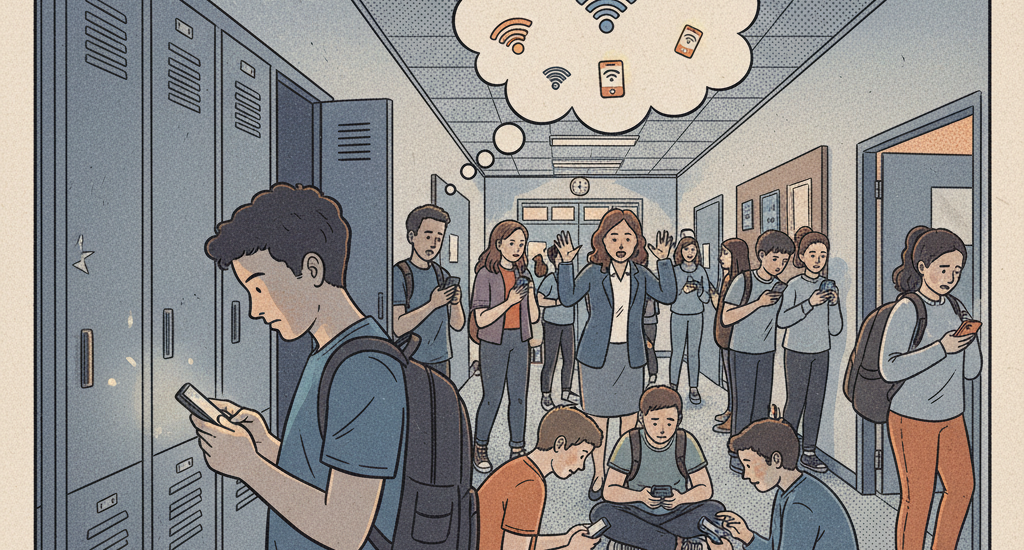

Hint: Cell Phones in Schools
Senate Education Committee Examines Cell Phone Use and Policy in Pennsylvania Schools
The Senate Education Committee recently convened a public hearing, chaired by Senator Lynda Schlegel Culver, to investigate how Pennsylvania schools are managing student cell phone use. The central goal was to determine whether statewide policy guidance is necessary to address growing concerns over classroom disruption, learning interference, and student safety. A wide array of voices testified, including educators, students, parents, and national policy experts, all offering diverse perspectives on how to best integrate or restrict technology in modern academic settings.
While the Pennsylvania Senate Education Committee’s hearing highlights a cautious, localized approach to managing student cell phone use, a closer look at the logistical and professional realities suggests that “guidance” and “tailored policies” may not be enough. The testimonies from students like Atticus Mitchell and Camryn Hoover underscore the distraction, but they only scratch the surface of a much deeper systemic issue.
The Logistical Mirage of “Tailored Policies”
The hearing discussed whether individual schools are better equipped to develop their own policies. However, “local control” often creates a logistical patchwork that is impossible to enforce effectively.
The Enforcement Gap: When policies vary by classroom or district, enforcement falls solely on the teacher. This turns educators into “tech police,” spending an average of 10–15 minutes per hour managing device infractions rather than teaching.
Physical Infrastructure Costs: For a ban to work, schools must invest in physical security. Systems like Yondr pouches (which lock phones away) cost approximately $30 per student. For a state like Pennsylvania, implementing this across all districts would require a massive capital outlay that “tailored policies” often lack the budget to cover.
The “Double Phone” Problem: Logistically, many students have learned to hand in a “decoy” phone while keeping their primary device hidden. Without a standardized, state-mandated security protocol, local schools lack the authority or resources to conduct the necessary checks to ensure compliance.
The Case for a Universal Ban: When Staff Are the Risk
The Senate hearing focused heavily on student behavior, but recent news stories demonstrate that the presence of personal cell phones is equally dangerous when in the hands of teachers and administrators. A ban is necessary to protect the professional integrity of the school.
The “Clout” Crisis (Privacy Violations)
In October 2025, a substitute teacher in DeSoto County was terminated immediately after using her personal phone to film students for a TikTok video. She recorded minors in the hallway and during a pep rally to gain social media followers, violating student privacy and school safety protocols. When teachers have unrestricted access to personal devices, the classroom becomes a “set” for content creation, turning students into unwitting props. A universal ban would eliminate the temptation for staff to prioritize “likes” over lesson plans.
The “Dark Channel” Problem (Grooming and Misconduct)
In late 2025, a veteran educator in Tennessee was charged with multiple felonies after using Snapchat on her personal device to exchange explicit photos with a student. Personal cell phones allow staff to bypass district-monitored servers and encrypted email systems, creating “dark channels” for grooming. By allowing personal devices in the building, schools provide a cloaked environment for misconduct. If teachers were restricted to district-issued devices for all communication, every interaction would be archived and transparent, significantly increasing student safety.
Is a Universal Ban Actually Feasible?
The Pennsylvania Senate Committee is right to worry about “parental expectations” for emergency access. However, we must ask: Is it feasible to ban cell phones for both teachers and students?
Yes, but only if we redefine school communication. A ban is feasible if—and only if—the state provides the funding to replace the “personal phone lifeline” with robust internal infrastructure. This includes:
- Hardwired Classrooms: Ensuring every room has a functional landline and high-speed, filtered internet for district-issued tablets.
- Professional Standards: Requiring teachers to store personal devices in secure lockers during instructional hours, much like employees in high-security government or medical facilities.
Supporting a universal ban isn’t about being “anti-tech”; it’s about being pro-focus. If Pennsylvania wants to solve the issues raised by Mitchell and Hoover, it must acknowledge that as long as a device is in a pocket—whether that pocket belongs to a student or a teacher—the temptation for distraction and the risk of misconduct will remain.
The Minefield: Beyond “Guidance”
The Senate’s discussion on “practical challenges” touched on parental expectations, but the legal reality of a phone ban is far more complex. Schools attempting to implement “bell-to-bell” bans face three primary legal hurdles:
Fourth Amendment and Privacy Liability: While schools have the right to seize property that violates policy, they do not have an automatic right to search it. Pennsylvania schools have already learned this the hard way: in a landmark settlement with the ACLU of Pennsylvania, the Tunkhannock Area School District was forced to pay $33,000 after a teacher confiscated a student’s phone for a policy violation and subsequently searched its private photos. A statewide mandate without strict legal protocols for “search vs. seizure” invites a wave of similar privacy litigation.
The Liability of Custody: Logistically, if a school mandates that 1,000 students lock their $1,200 smartphones in magnetic pouches or lockboxes, the school district assumes “bailment” or legal responsibility for that property. In 2025, school boards are increasingly concerned about the financial risk of a single “security breach” or locker room theft that could result in tens of thousands of dollars in property damage claims for which the district may be held liable.
Collective Bargaining and Labor Law: Banning phones for staff—an essential step for professional consistency—runs directly into labor law. Personal cell phones are considered personal property; requiring teachers to surrender them can be viewed as a change in “working conditions” that must be negotiated with unions like the PSEA (Pennsylvania State Education Association). Without a state-level legislative shield, individual districts face grueling contract disputes just to implement basic device restrictions for adults.
The Logistical Burden: Enforcement and Costs
The Senate hearing reviewed data from 30 states, but often overlooked the “arms race” of enforcement:
“Pouch Hacking”: In districts using systems like Yondr, students have popularized “hacks” using high-powered magnets to bypass locks. This forces staff into a constant, distracting cycle of physical inspections.
The Financial Toll: Implementing physical storage solutions across a state like Pennsylvania would cost millions. For context, recent estimates for universal storage in large urban districts have topped $5 million to $7 million in initial hardware alone, not including annual replacement costs for broken or lost units.
Why a Staff Ban is Non-Negotiable
While the Senate hearing focused on students like Mitchell and Hoover, the most compelling reason for a universal ban—one that includes teachers—is the prevention of professional misconduct.
The Collective Bargaining Wall: Union and Labor Challenges
In Pennsylvania, the terms and conditions of a teacher’s workday are governed by collective bargaining agreements. Implementing a cell phone ban for staff is not a simple policy shift; it is a major change to working conditions.
The Unfair Labor Practice (ULP) Risk: If a district unilaterally bans personal devices without negotiating with unions like the PSEA (Pennsylvania State Education Association), they face immediate legal challenges. Unions argue that personal devices are essential for teacher safety and for accessing district-required digital tools.
The 2FA Logistical Loop: Most modern school districts use Two-Factor Authentication (2FA) for teachers to log into grading systems (like PowerSchool) or email. These systems often send a code to a personal cell phone. Logistically, a ban on teacher phones would effectively lock educators out of their own professional software, unless the district spends thousands of dollars providing every staff member with a physical security token (like a YubiKey).
Professional Agency: The Need for “Adult” Communication
Teachers are trained professionals who must manage their classrooms and their personal lives simultaneously. Stripping them of their devices ignores their agency as adults.
Emergency Parental Contact: In many older Pennsylvania school buildings, classroom landlines are unreliable or lack “outside” lines. Teachers frequently use their personal devices to make sensitive calls to parents regarding a student’s medical needs or urgent behavioral issues. Forcing a teacher to leave their classroom to find a “public” office phone to call a parent is a logistical failure that wastes valuable instructional time.
The “Double Standard” vs. Reality: While students are in a developmental stage where they struggle with impulse control, teachers are adults with the agency to use technology responsibly. Treating educators like students by confiscating devices undermines their authority and professional standing, making it harder to recruit and retain talent in a competitive labor market.
The Logistical Failure of “Contacting Home”
A ban on personal devices creates a communication vacuum that schools are currently unequipped to fill.
The Emergency “Blackout”: Consider a scenario where a teacher is an “adult sandwich-generation” caregiver. If a teacher’s child is injured at daycare or an elderly parent has a medical emergency, the school’s front office becomes a bottleneck. In high-enrollment districts, the administrative staff cannot realistically manage the influx of personal emergency calls for 100+ staff members. A ban removes the teacher’s ability to be reachable for their own family, creating a workplace environment of high stress and low morale.
The Vanishing Landline: Many modern “tailored policies” discussed in the Senate hearing assume every classroom is an island of connectivity. However, if a teacher needs to contact a parent to discuss a student’s progress—often a requirement of their contract—and the school’s internal VOIP (Voice over IP) system goes down due to a local internet outage, the personal cell phone is the only backup. Without it, the school’s ability to maintain the parent-teacher bridge is completely severed.
Video and written testimony from the hearing are available at education.pasenategop.com.