

Career and Technical Education (CTE) is no longer the “vocational school” of the past. Today, it represents a high-tech, high-skill pathway that prepares students for the modern workforce through hands-on learning and industry-recognized certifications. If you are a parent or student considering this path, the following expanded checklist will guide you through the transition from curiosity to enrollment.
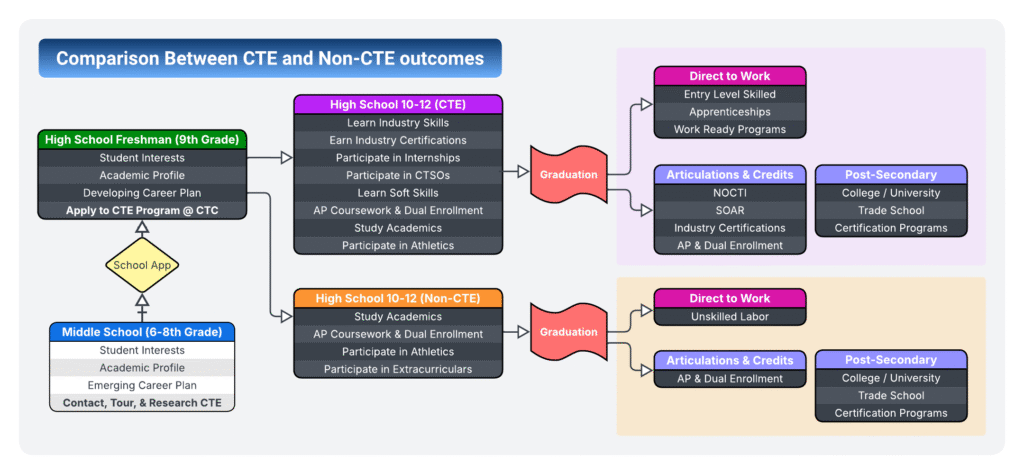
Find Your Local Career Technical Center (CTC)
The first step is identifying which institutions serve your specific school district. These centers are often regional hubs where students from multiple high schools congregate for half-day or full-day specialized instruction.
- If you’re in Pennsylvania: Use the PA Department of Education CTC Map. Pennsylvania has a robust network of over 80 CTCs offering programs ranging from mechatronics to culinary arts.
- If you’re in New Jersey: Visit the NJ Council of County Vocational-Technical Schools. NJ utilizes a county-based system, often providing full-time comprehensive technical high schools.
- Benefits: Locating your center early allows you to understand transportation logistics and the specific relationship between your “home” high school and the technical center.
Determine Programs That Align with Interests and Personality
A student’s success in CTE is highly dependent on “fit.” Unlike a general education track, CTE requires a deep dive into a specific craft. Personality tests help students move past “what sounds cool” to “what suits how I think.”
- The Social Student: Might thrive in Cosmetology, Healthcare, or Public Safety, where interpersonal communication is the core of the work.
- The Analytical Student: Often excels in Computer Networking, Cybersecurity, or Biomedical Technology.
- The Kinesthetic (Hands-on) Student: Usually finds a home in Welding, Automotive Technology, or Carpentry.
Use these tools to start the conversation:
- 16 Personalities: A free, user-friendly version of the Myers-Briggs theory that provides insights into workplace habits.
- The Myers-Briggs Type Indicator (MBTI): A more formal assessment used by corporate HR departments worldwide.
- Truity’s Holland Code Assessment: This specific test measures interest in Six Areas: Realistic, Investigative, Artistic, Social, Enterprising, and Conventional (RIASEC).
Find Occupations Using Government Data
Once you have a personality profile, you need to see where those traits meet the real-world economy. The goal is to bridge the gap between a student’s hobby and a sustainable paycheck.
- O*NET Interest Profiler: Sponsored by the U.S. Department of Labor, O*NET Online is the gold standard for career data. It allows students to see the “Day in the Life,” required tools, and technology for thousands of jobs.
- MAPP Career Test: The Motivational Appraisal of Personal Potential provides a detailed narrative of how a student likes to work (e.g., working with data vs. working with people).
- Benefits: Using these tools prevents “career shock”—when a student realizes too late that their chosen field requires math levels or physical demands they weren’t prepared for.
Identify High-Priority and Accessible Careers
Not all careers are created equal in terms of job security. You want to identify High Priority Occupations (HPOs)—jobs that are in high demand by employers, have higher-than-average wages, and offer a clear path for advancement.
- Examples: Currently, fields like HVAC (Heating, Ventilation, and Air Conditioning), Logistics & Supply Chain Management, and Licensed Practical Nursing (LPN) are considered high-priority in most states.
- How to check: Search your state’s Department of Labor website for “High Priority Occupations” lists.
- Benefits: Choosing an HPO ensures that after graduation, the student isn’t just “trained,” but “hirable.” It maximizes the Return on Investment (ROI) of their education.
Align Local CTC Programs to Interests
Now, cross-reference your child’s top career choices with the actual course catalog of your local CTC.
- The Matching Process: If your child’s test results point toward “Realistic/Engineering” and your local CTC offers Precision Machining, that is a high-value match.
- Example: If they are interested in animals but the local CTC only offers Veterinary Assisting (and they want to be a Surgeon), discuss how this program serves as a foundational “stepping stone” rather than the final destination.
- Benefits: This step manages expectations. It helps students understand that the CTC is a specialized environment designed to kickstart a specific professional trajectory.
Contact Your School Counselor
The school counselor is the gatekeeper of the application process. They handle the “paperwork” side of the transition, ensuring that the student’s credits at the CTC will count toward their high school graduation requirements.
- What to ask: “What is the application deadline?” “How does the busing schedule work?” and “Does this program offer Dual Enrollment (college credit)?”
- Benefits: Counselors often have “insider” knowledge about which programs are the most competitive and can help strengthen a student’s application.
Contact Your Local CTC Directly
While the high school counselor handles the logistics, the CTC staff handles the content. You should reach out to the CTC Admissions Office or the specific Program Instructor.
- The Timeline: Contact them at least one year in advance. Many popular programs (like Welding or Dental Assisting) have long waiting lists.
- Ask about Certifications: “Which Industry Recognized Credentials (IRCs) will my child earn?” (e.g., NOCTI, OSHA-10, AWS Welding, or NIMS).
- Benefits: Speaking with instructors directly gives you a feel for the shop culture and the type of equipment the students will be using.
Tour the Facility and Apply
You would never buy a house without walking through it; the same applies to a technical education. Most CTCs hold “Open Houses” in the winter or spring.
Benefits: A physical tour often turns “nerves” into “excitement.” Once a student sees the $100,000 machines or the professional-grade kitchens, the career path becomes a tangible reality.
What to look for: Observe the safety protocols, the cleanliness of the labs, and the engagement level of the current students. Ask to see the Career Services office, which helps students find jobs after graduation.
The Final Step: Ensure the application is submitted completely. Many CTCs require an essay, a record of good attendance, and a recommendation from a teacher.
For a more detailed breakdown of the Middle School to Post-Secondary process