

SOAR (Students Occupationally and Academically Ready) is Pennsylvania’s system of statewide program articulations. A CTE SOAR articulation links a named high-school Program of Study (POS) to specific courses or credits at participating colleges. If students meet the POS requirements (including grades and assessments) and enroll at the receiving college within the program’s rules, they can receive the agreed college credit. The PA Dept. of Education explains the SOAR program and points students to the statewide transfer/search tools. Pennsylvania Government+1
SOAR examples
- Commercial & Advertising Art (POS 11F) — this SOAR mapping shows that students who complete the POS can receive 9 credits that map to community-college design courses (examples: ART/Digital Design classes at Luzerne County Community College and Lehigh Carbon Community College; links and mapping are listed on the PA course equivalency pages). College Transfer+1
- Welding Technology / Welding programs — Pennsylvania curriculum materials and program guides explicitly note that Welding POS students can earn college credits through statewide and local articulations (and that industry credentials like AWS/NOCTI are part of the aligned pathway). Pennsylvania Government
Action Items for Teachers
Teachers can take the following three steps to increase awareness and participation in SOAR programs:
1. Conduct Live Demonstrations of the Search Tool: During parent-teacher conferences or student orientation, teachers should use CollegeTransfer.net to show exactly how their specific Program of Study (POS) transfers. By inputting the student’s graduation year and Program of Study, teachers can display the specific postsecondary institutions that will award nine or more technical credits, making the benefit tangible for families.
2. Distribute Multi-Language and Visual Resources: Teachers should utilize the SOAR Bulletin, which is available in both English and Spanish, to reach a diverse range of families. Additionally, providing the SOAR Flyer found on the Programs of Study resource page can serve as a quick reference guide for parents to understand the “non-duplicative” nature of the coursework.
3. Incorporate Instructional Media into Curriculum: Teachers can play the “SOAR – Statewide Articulation Agreements for CTE Teachers” YouTube video in class. This helps students understand that their high school effort directly leads to a postsecondary diploma, credential, or associate degree, effectively “pre-earning” college progress.
4. Documentation Readiness Teachers should integrate the Programs of Study (POS) Student Documentation Coversheet and the Competency Task List into their classroom planning to make the requirements transparent to students,. Since postsecondary institutions only award credit upon a student meeting “all of the Program of Study requirements,” teachers can use these documents as a checklist to show students exactly which skills are required to earn the nine or more technical credits,. By explicitly linking daily classwork to the official task list, teachers demonstrate that the curriculum is rigorous and validated by “business and industry partners” who participate in the mandatory task list revision process.
5. Clarify the Matriculation Timeline Teachers must ensure graduating seniors understand that SOAR credits are not awarded automatically; the student must formally enroll and become a “matriculated student” at the participating postsecondary institution to receive the credit,. Teachers should emphasize the critical deadline, informing students that they generally have “up to 16 months after high school graduation” to apply for and receive these credits. Clarifying this timeline helps prevent the common issue where students are eligible for credit but fail to receive it because they did not complete the specific administrative steps required after leaving high school.
Key Take Aways for Principals and Counselors
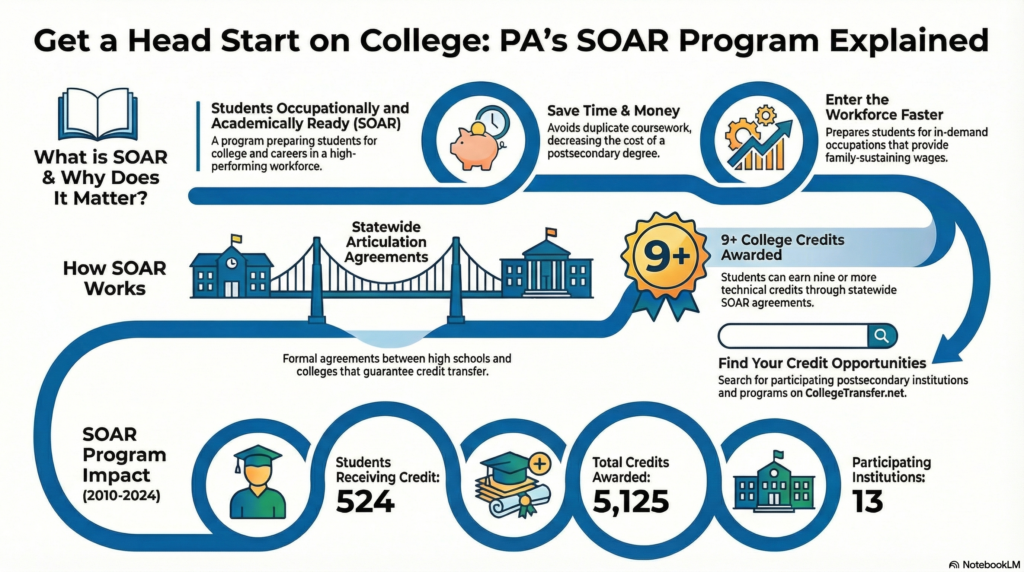
When interacting with parents and the general public, administrators should emphasize these four key points to highlight the program’s impact:
• Significant Cost Savings Explanation Strategy: When explaining this benefit, focus on the specific value of “non-duplicative” coursework. You can explain that because Statewide Articulation Agreements award “nine or more technical credits,” families are effectively saving the tuition equivalent of at least three college courses,. Emphasize that because the student has already mastered these skills in high school, they do not need to pay for or repeat introductory courses at the college level, thereby directly lowering the total price tag of their associate degree or technical certificate.
• Pathways to High-Sustaining Wages Explanation Strategy: To explain why these programs lead to better wages, highlight the direct involvement of employers in the curriculum design. You can explain that the Competency Task List (the list of skills taught in the class) is not static; it is revised every three years by a committee that includes mandatory participation from “business and industry partners”. This ensures the curriculum focuses on “high demand” skills that employers are currently seeking, positioning students for careers that offer “family sustaining wages” rather than entry-level, minimum-wage jobs.
• Time-Sensitive Eligibility Explanation Strategy: Clarify that SOAR credits operate on a “use it or lose it” basis with a strict administrative deadline. Explain that the credits are not awarded automatically upon high school graduation; the student must formally enroll and become a “matriculated student” at the participating college to trigger the award,. Crucially, inform families that this opportunity expires: beginning with the 2021 cohort, students generally have a window of “up to 16 months after high school graduation” to apply these credits toward a diploma, certificate, or degree.
• Academic and Technical Rigor Explanation Strategy: Frame the credits as “earned” rather than “given” to validate the student’s hard work. Explain that the postsecondary institution awards credit only when a student meets “all of the Program of Study requirements,” which includes mastering the Competency Task List and passing the End of Program Assessment,. Because these articulated courses “may not have conditions or prerequisites” attached to them at the college level, the high school program effectively serves as the prerequisite, proving the student has already achieved technical proficiency.
(You can search the PA SOAR portal / Course Equivalency pages to look up a specific POS and the exact college courses/credit values tied to it.) College Transfer