

How a CTE program differs from a high school elective course.
The Occupational Advisory Committee (OAC) serves as a vital link between Career and Technical Education (CTE) programs and the regional business and industry community. The primary benefit of an OAC is to strengthen the program by ensuring the curriculum remains technologically current and aligned with the actual needs of the workforce. Programs that maintain a close association with an active OAC are generally more successful in preparing students for employment than those that do not.
OACs provide essential technical assistance by advising school boards and staff on curriculum content, equipment selection, and safety requirements. These committees are responsible for verifying that programs meet rigorous industry standards and prepare students with the specific competencies required for their chosen occupation,. By reviewing facility layouts and instructional materials, OAC members ensure that the learning environment accurately simulates a real-world professional setting.
Professionals can get involved in OACs as representatives of business, industry, or labor, provided they are active in the specific occupation for which training is provided. By law, the majority of the committee must be employees and employers from the relevant industry. Interested experts are typically formally appointed by the school’s board of directors to serve in an advisory capacity. While school personnel may facilitate meetings, the chairperson is ideally a business representative, ensuring the committee remains industry-driven.
Beyond formal meetings, professionals serve the program and students by participating in work-based learning activities, such as providing guest lectures, hosting field trips, and facilitating internships or cooperative education placements. They also play a critical role in student assessment by acting as proctors or evaluators for hands-on portions of national exams like the NOCTI or NIMS. Their direct feedback on student performance helps instructors identify and close gaps between the classroom and the job market.
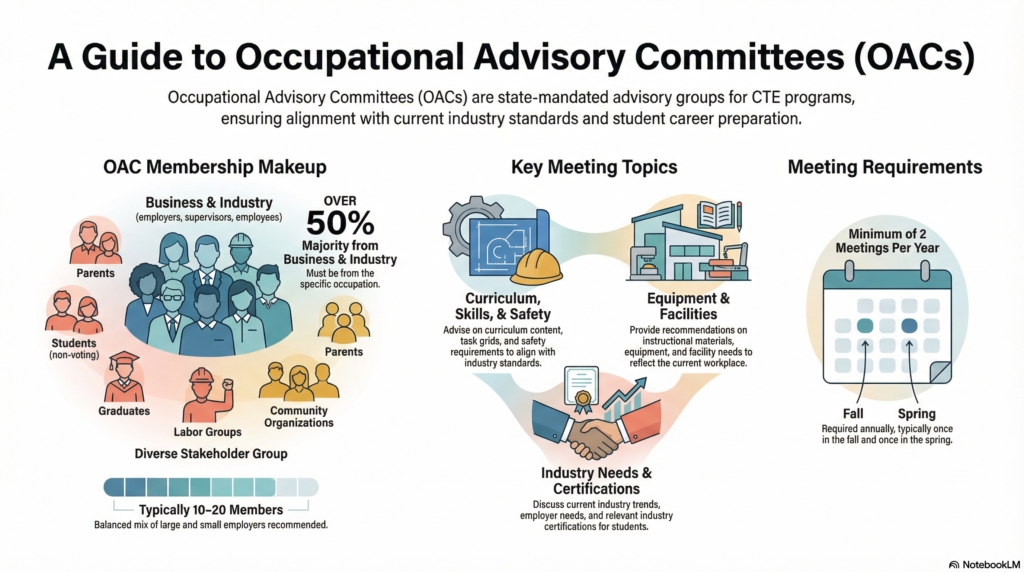
An OAC serves the broader community by aligning education with local economic needs, ensuring that taxpayer-funded programs produce highly skilled workers ready for high-priority occupations. By articulating the value of CTE to parents and community leaders, OAC members increase public awareness of career pathways and local workforce opportunities,. This collaboration fosters regional economic growth by providing a reliable pipeline of qualified graduates who can sustain and expand local businesses.
Recruitment & Retention Strategies
Teachers can recruit new members by visiting local employers during professional development days to build personal relationships and identify master-level technicians. Inviting these professionals to serve as guest speakers or NOCTI evaluators acts as a low-pressure entry point that often leads to permanent committee service. Additionally, teachers should have and keep industry contacts after leaving their profession to become teachers.
Retention is significantly strengthened when teachers collaborate with administrators to provide timely, written responses to OAC recommendations, proving to members that their advice is impactful. Providing official recognition through certificates and plaques presented at board meetings further validates the members’ expertise and solidifies their professional bond with the school.
Teachers should maintain a diversity of perspectives by recruiting from both large and small employers while involving postsecondary representatives to ensure a seamless student transition. Efficiently managed meetings that start on time and focus on seeking advice rather than just providing reports respect the schedules of busy professionals and encourage consistent attendance.
OAC Responsibility
Maintaining an OAC is a collective responsibility, though the burden can be onerous for a CTE teacher who serves as the primary contact, recruiter, and facilitator. While the instructor is legally tasked with forming the group and managing daily interactions, the CTE director or principal must provide critical oversight by formally appointing members and ensuring that recommendations reach the school board for action. Delegating these tasks solely to the teacher risks “minimum compliance” rather than true program excellence, as administrative attendance at meetings is essential to provide the immediate feedback and “buy-in” that industry members expect. Ultimately, the most effective OACs function as a partnership where the teacher manages the technical relevance of the curriculum while the administration provides the organizational authority and logistical resources to sustain employer engagement.
For more information on PA Occupational Advisory Committees, click here.
From compliance to impact: making OACs a true program advantage
Occupational Advisory Committees are most valuable when they function as active improvement engines rather than compliance checkboxes. The strongest OACs provide specific, actionable feedback on curriculum alignment, equipment relevance, safety practices, and work-based learning quality.
Committees should be structured to reflect the diversity of local labor demand. Including employers from different firm sizes and subsectors gives programs better insight into both current hiring needs and emerging skill shifts. Postsecondary representation can also improve transition planning and credential stackability.
Meeting quality matters. OAC sessions should prioritize decision-focused agendas, evidence review, and follow-up accountability. When recommendations are tracked with visible status updates, participation quality improves and members are more likely to stay engaged over time.
For teachers, OACs can reduce isolation by creating a practical feedback loop with industry. For students, active committees can improve classroom relevance and increase access to internships, mentors, and authentic assessments.
District leaders should treat OAC performance as a strategic indicator. Programs with high-functioning advisory structures often show stronger employer trust and better long-term outcomes.
Operational upgrades for OAC effectiveness
- Use annual competency reviews to ensure curriculum reflects current tools and standards.
- Track recommendation follow-through and report actions at each meeting.
- Build a pipeline for new committee members to prevent participation fatigue.
- Link OAC feedback directly to pathway improvement plans and budget priorities.