
Why this federal budget vote matters more than the headline suggests
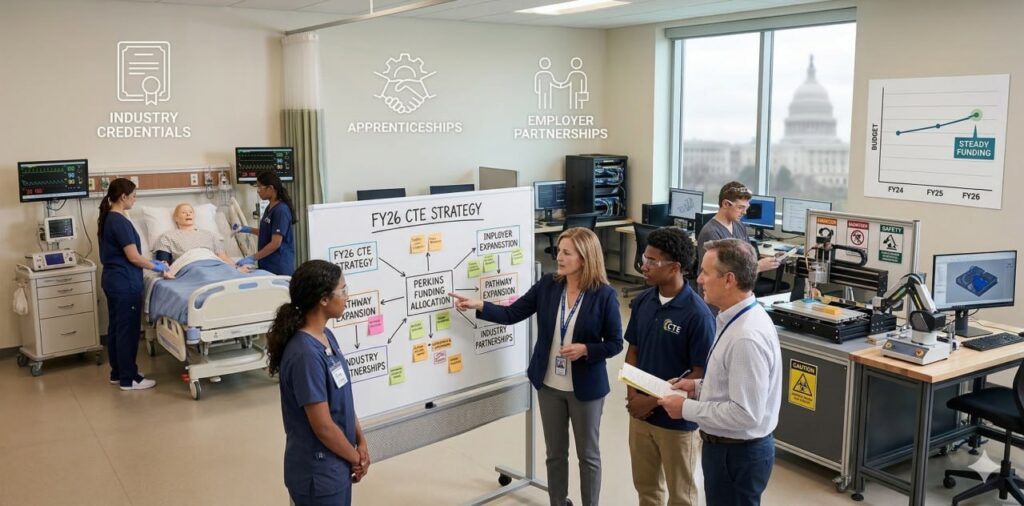
When Congress finalizes a federal education budget, the first public question is usually simple: did funding go up, go down, or stay the same? For career and technical education, the FY26 outcome around Perkins V state grants landed in the “stayed the same” category. On paper, that can feel unremarkable. In practice, it is anything but.
For state CTE agencies, regional intermediaries, and local districts, stable formula funding is the backbone that keeps multi-year plans from falling apart. It keeps pathway redesigns moving, protects staffing commitments, and prevents constant stop-start cycles in programs that require expensive equipment, certifications, and employer coordination. In a federal climate where many lines faced pressure, level funding can function as a stabilizer.
That does not mean CTE systems are fully protected. Inflation, wage pressure, and rising technology costs continue to erode purchasing power. So this moment is best understood as a planning window: enough fiscal predictability to execute with discipline, but not enough new money to hide weak design choices.
Stabilization is useful, but it is not expansion
The FY26 package appears to preserve core Perkins support rather than expand it. That distinction matters for leadership teams making budget assumptions.
If a state or district treats “level funding” as equivalent to “business as usual,” quality can still drift backwards. Program costs in advanced manufacturing, health care simulation, and IT pathways rarely remain flat. Consumables, software licenses, maintenance contracts, and instructor recruitment costs move faster than general inflation in many regions. A district can receive the same federal allocation and still experience a real drop in instructional capacity.
At the same time, level funding does provide one major advantage: planning confidence. Leaders can lock in multi-year implementation calendars with more confidence than they could under threat of abrupt cuts. That can improve execution quality, especially when agencies focus on completion rates, credential quality, and labor-market alignment rather than raw enrollment alone.
What this means for state CTE agencies right now
State agencies should use this cycle to increase the “return on every Perkins dollar” narrative, not just compliance reporting. Federal continuity gives states an opportunity to sharpen how funds are braided, measured, and communicated.
Priority moves for state teams include:
- Tightening quality definitions for high-value credentials so local recipients are rewarded for outcomes that matter to employers and families.
- Improving guidance on allowable uses that directly support learner persistence, including transportation, advising, and transition supports.
- Refreshing reserve fund strategy to focus on equity, rural access, and hard-to-staff pathway priorities.
- Building clearer evidence packs for legislators and workforce boards that connect Perkins investments to workforce readiness and placement trends.
States that can demonstrate measurable outcomes under stable funding will be better positioned when future federal cycles reopen debates about growth, reauthorization, or reallocation.
District leaders: protect implementation capacity, not just line items
At the local level, budget continuity can still produce stress if districts do not guard implementation capacity. CTE programs are operationally complex. A pathway can appear funded on paper while losing quality due to vacant instructor positions, reduced employer coordination time, or cuts in student supports.
District and school-system leaders should focus on protecting the high-leverage elements that make pathways actually work:
- Instructor quality and retention in high-demand fields.
- Work-based learning brokerage capacity (someone has to build and sustain employer placements).
- Advising and navigation supports so students can enter and persist in pathways.
- Partnerships with community colleges and training providers that maintain dual-enrollment and stackable credential options.
Without these pieces, systems can keep course catalogs intact while losing the student outcomes that justify CTE investment.
Employer partnerships become even more important under flat federal dollars
When federal funding is stable but not growing, employer partnerships are no longer “nice to have” enhancements; they become risk management tools.
Strong employer partnerships can offset pressure by contributing in ways that are not purely cash-based:
- Donating or lending equipment aligned with current industry standards.
- Providing paid internships or youth apprenticeship seats.
- Co-designing competencies so curriculum does not lag labor-market needs.
- Supporting instructor externships that keep teaching aligned with modern practice.
The key is to formalize these partnerships with explicit role clarity, timelines, and quality checks. Informal goodwill is helpful but unstable. Structured agreements give districts more predictable capacity when public dollars are tight.
Equity stakes remain high even when funding avoids cuts
A common policy mistake is assuming that “no cut” means “no harm.” For learners furthest from opportunity, stagnant capacity can still widen access gaps.
Transportation, scheduling flexibility, support services, and counseling are often the first pressure points when local budgets tighten. Yet these are exactly the supports that enable low-income students, multilingual learners, and students with caregiving responsibilities to persist in CTE pathways.
If systems protect only the visible technical components (labs, courses, equipment) and underfund participation supports, completion and credential attainment gaps can widen even while enrollment stays steady. Leaders should treat equity supports as core infrastructure, not extras.
The signal to watch: quality and completion, not just participation
During funding-stable years, agencies often celebrate participation totals. Participation matters, but it is not enough.
The stronger signal for this cycle is whether systems can improve:
- Concentrator completion rates.
- Attainment of high-value credentials.
- Successful transitions to postsecondary pathways or quality employment.
- Wage and retention outcomes where data systems allow tracking.
If the field can show meaningful gains on these indicators under stable funding, the case for future investment becomes much stronger than a narrative built only on enrollment growth.
The good, the bad, what’s best?
The good: Congress preserving core Perkins support creates planning stability at a time when many programs faced uncertainty. For CTE systems that are execution-ready, this supports continuity in pathway implementation, staffing plans, and state-local coordination.
The bad: Level funding in a high-cost environment can behave like a quiet cut. Districts still face inflation, labor shortages, and equipment replacement cycles that reduce real purchasing power. Systems that mistake stability for sufficiency may lose quality over time.
What’s best: Treat FY26 as a discipline year. Use stable dollars to strengthen quality controls, protect learner supports, and deepen employer co-investment. Build evidence now—completion, credential value, and workforce outcomes—so the next federal budget debate is about scaling proven impact, not defending baseline survival.
Practical 12-month playbook for CTE teams
For agencies and districts that want to turn stabilization into momentum, a focused operating plan can help:
- Run a pathway viability audit. Identify where staffing, equipment, and work-based learning capacity are currently at risk.
- Prioritize high-value credentials. Reallocate where necessary toward programs with clear labor-market payoff.
- Stabilize support services. Protect transportation, advising, and transition supports tied to persistence and completion.
- Formalize employer commitments. Move from informal support to documented partnership agreements.
- Publish outcome dashboards. Share concise, credible data with boards, families, and policymakers quarterly.
- Prepare a growth case now. Build the narrative and evidence needed for future expansion requests before the next federal cycle begins.
This approach keeps systems from drifting into maintenance mode and positions CTE leaders as proactive stewards of public dollars.
✅ Recommendation: Use FY26 stability to prove measurable value before the next budget fight
If CTE leaders respond to this moment with focus, FY26 can become a strategic bridge year: not flashy, but powerful. The headline is “steady funding,” but the opportunity is operational. Systems that improve quality, equity, and workforce outcomes now will have the strongest case for future growth and the greatest credibility with families, employers, and lawmakers.