
Source
https://www.govtech.com/education/k-12/new-cte-course-trains-students-to-repair-chromebooks
Why this headline matters beyond device break-fix
At first glance, a student Chromebook repair course can look like a niche operational story: schools have lots of damaged devices, budgets are tighter than they were during peak federal relief years, and districts need lower-cost maintenance options. That reading is correct, but incomplete. The larger significance is that this initiative reframes a common district pain point into a formal career pathway with labor-market relevance.
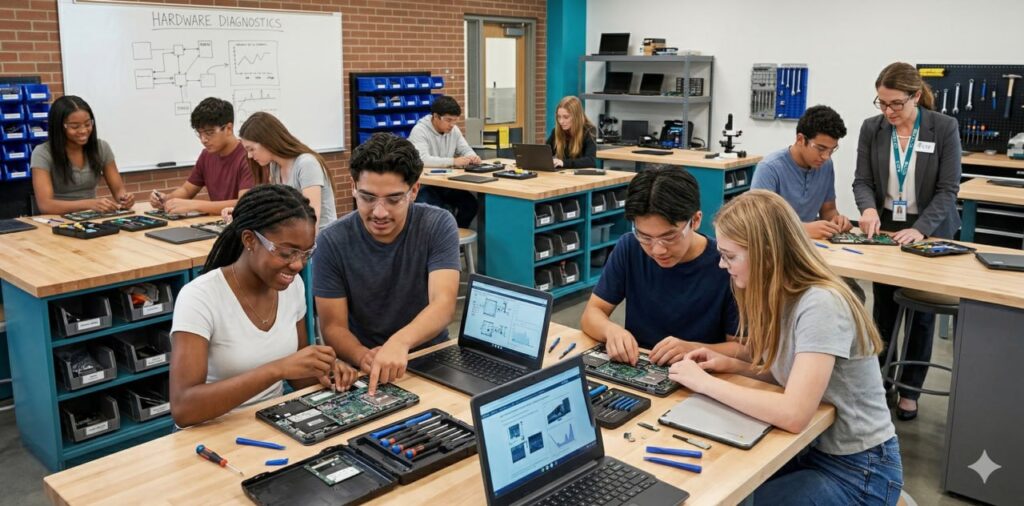
GovTech reports that CTL’s Chromebook Care Course is designed to train and certify middle and high school students as repair technicians. In practical terms, this creates a structured bridge between school technology operations and CTE outcomes. Instead of students only learning abstract IT concepts, they work on real hardware, real diagnostics, and real service workflows. That direct application is exactly the type of authentic task environment that CTE leaders have been trying to scale for years.
This model is also a signal of how districts are adapting post-ESSER. During rapid 1:1 expansion, many systems prioritized device acquisition over long-term sustainment planning. Now the maintenance burden is visible: aging fleets, recurring breakage, slower refresh cycles, and pressure on understaffed IT teams. A course that turns this burden into a student learning opportunity is strategically appealing because it can address cost, staffing, and student engagement at the same time.
The caution is that programs like this can be oversold. There is a difference between authentic pathway learning and low-level task outsourcing to students. The credibility of this model depends on whether it includes meaningful competency progression, instructor oversight, safety and data-handling guardrails, and recognized credentials that carry value beyond one district’s help desk needs. If those design elements are weak, the initiative remains operationally useful but educationally shallow. If those elements are strong, this can become a replicable entry point into broader IT and cybersecurity talent pipelines.
From student demand to district strategy: who benefits and how
Students are the most visible beneficiaries when this kind of pathway is built correctly. They gain technical fluency in troubleshooting, component replacement, quality control, and device lifecycle thinking—skills that map directly to entry-level support roles and can scaffold into higher pathways such as network support, systems administration, and cybersecurity operations. Just as important, they gain employability behaviors that are hard to teach in traditional lecture models: ticket handling, communication with users, documentation standards, and accountability for service outcomes.
Families may also view this pathway as a high-value option because it combines practical skill development with immediate relevance. In many communities, students and parents increasingly ask a straightforward question: “How does this class connect to real opportunity?” A student-led repair model offers a concrete answer. Learners can demonstrate what they know, earn certification, and potentially translate that experience into internships, part-time roles, or stronger positioning for postsecondary technology programs.
District leaders benefit if they avoid short-term thinking. The temptation is to measure success only through reduced repair costs or faster device turnaround. Those are useful metrics, but they are not enough for CTE governance. Strong district strategy should include educational KPIs: completion rates, certification attainment, quality of technical assessments, transition outcomes, and employer validation of skill readiness. A program can save money and still fail as CTE if learners are not progressing toward durable workforce value.
Teachers and program staff carry substantial implementation load. A successful model requires instructors who can blend pedagogy with technical rigor, maintain safe lab practices, align student work with quality standards, and coordinate with IT departments without turning class time into a pure service queue. That coordination is nontrivial. If districts launch quickly without staffing depth or professional development, instructor strain becomes the first bottleneck and program quality declines soon after.
Technology teams and administrators can gain operational relief, but only if the school designs clear boundaries between instructional activities and production support. Students should not become replacement labor for core IT functions. They should participate in structured learning tasks with supervised progression, transparent expectations, and reflection built into the workflow. In other words, districts should treat operational benefit as a positive byproduct of a learning-first model, not the primary objective.
What could scale well, and where implementation can fail
There is a credible scaling path here, but it depends on discipline. The strongest opportunity is that nearly every district now has a large installed device base and ongoing maintenance demand. That creates a broad replication surface. Unlike pathways that require highly specialized local industry anchors, student device support can be launched in many regions if curriculum, tools, and instructor support are standardized.
A second opportunity is pathway stacking. Chromebook repair can serve as a gateway course that leads into more advanced IT outcomes: hardware fundamentals, networking, endpoint management, scripting for automation, secure device handling, and eventually cybersecurity concepts. If leaders design this as a progression rather than a one-off elective, students can move from practical service tasks to higher-value technical roles over time.
A third opportunity is partnerships. Districts can collaborate with community colleges, local MSPs, and IT employers to validate competencies, offer mentorship, and define preferred hiring signals. These partnerships can convert school-based experience into recognized career momentum. Without external validation, students may gain useful skills but still struggle to communicate their value in hiring environments.
The failure modes are just as predictable. First, quality dilution: expansion without instructor capacity can reduce the program to repetitive low-skill tasks. Second, credential inflation: if certification signals are weak or not aligned to employer expectations, students may complete the pathway without meaningful labor-market advantage. Third, compliance and data risk: device repair can expose students to privacy-sensitive information if procedures and supervision are not explicit and enforced.
Districts also need to manage equity risk. If enrollment skews toward specific student groups, the pathway may unintentionally reinforce access gaps rather than close them. Program design should include transparent enrollment criteria, active outreach, and support structures so participation reflects broad student opportunity—not just students who already have technical confidence or prior exposure.
Finally, districts should resist the narrative trap that every operationally useful innovation is automatically CTE excellence. The standard should remain outcome credibility. Are students demonstrably more prepared for next-step education and employment? Are employers and postsecondary partners validating readiness? Are pathway completers seeing better transitions than comparable peers? If those answers are not improving, the model needs redesign no matter how efficient the repair queue becomes.
The good, the bad, what’s best?
The good: This model is practical, timely, and aligned with visible district needs. It offers students authentic technical practice in an environment where outcomes are measurable and immediately relevant. It can reduce device downtime, stretch budgets, and create an accessible on-ramp into IT careers for learners who may not engage with abstract computer science pathways.
The bad: Without guardrails, the pathway can drift into low-level labor substitution. Students may perform repetitive tasks without deeper competency development. Program quality can also drop if staffing, curriculum updates, and safety/compliance procedures are underbuilt. There is also a reputational risk: if certification quality is weak, stakeholders may perceive the pathway as “busy work with a badge” rather than rigorous CTE.
What’s best: Treat this as a phased CTE strategy, not a quick operational fix. Districts should define non-negotiable quality thresholds before scaling: instructor-to-student ratios, competency rubrics, secure data-handling protocols, external credential alignment, and verified next-step outcomes. They should also publish a simple performance dashboard that tracks both operational and educational indicators.
A balanced recommendation is clear: adopt and expand this model where implementation capacity exists, but tie expansion to transparent evidence of student value. Benefits do outweigh drawbacks when governance is strong, pathway design is progression-based, and outcomes are measured beyond cost savings.
✅ Proceed with expansion, but protect educational integrity.
Districts should move forward with student Chromebook repair pathways because the strategic logic is sound: it connects immediate institutional need with workforce-relevant student learning. However, they should institutionalize quality controls from day one—competency-based assessment, supervised workflow standards, credible credential mapping, and transition tracking into internships, postsecondary programs, or entry-level IT roles.
If leaders hold that line, this pathway can become a scalable model for modern CTE: practical, equitable, and economically relevant. If they chase scale without rigor, short-term operational gains will come at the expense of long-term pathway credibility.