
Source Link: ACTE Policy Watch
—
A Legislative Victory for Career Education
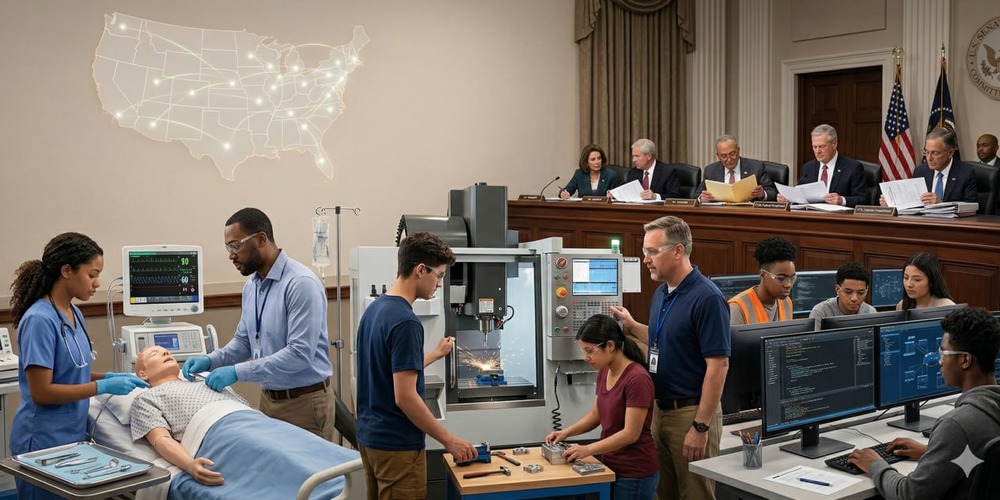
In a significant demonstration of bipartisan commitment to workforce development, Congress has approved a Fiscal Year 2026 appropriations package that allocates over $209 million in dedicated funding to 159 distinct Career and Technical Education projects across the nation. Signed into law in March 2026, this funding represents not merely a budgetary line item but a strategic federal investment in the educational infrastructure that prepares American workers for an evolving economy.
The earmarked funding arrives at a critical moment for CTE advocates who have spent years building the case that career education deserves parity with traditional academic pathways. With 37 states receiving targeted CTE appropriations, the geographic distribution signals broad congressional recognition that workforce readiness is neither a regional concern nor a partisan issue. The funding package demonstrates that legislators across the political spectrum have internalized a fundamental reality: America’s economic competitiveness depends directly on the quality and accessibility of its technical training programs.
This appropriations victory comes alongside parallel efforts by the House CTE Caucus, whose leadership has been actively circulating a “Dear Colleague Letter” advocating for even greater CTE investment in the upcoming FY 2027 budget cycle. The dual tracks—current funding secured and future expansion sought—illustrate the maturation of CTE as a sustained legislative priority rather than a cyclical budgetary afterthought.
Regional Distribution Reveals Strategic Priorities
An examination of how the $209 million is distributed across states reveals telling patterns about regional workforce needs and political influence. Mississippi emerges as the top recipient with $16 million in earmarked funding, a figure that suggests either concentrated investment in specific large-scale initiatives or successful advocacy by the state’s congressional delegation. This level of funding for a relatively small state indicates that Mississippi has positioned CTE as central to its economic development strategy, possibly linking technical training directly to specific industry recruitment or infrastructure projects.
Meanwhile, Michigan and Maryland share the distinction of having the most funded projects at 10 each, though with presumably smaller per-project allocations than Mississippi’s concentrated investment. This approach—spreading funding across numerous initiatives—may reflect different strategic calculations. Michigan’s manufacturing heritage and ongoing transition to advanced manufacturing and electric vehicle production likely drives demand for diverse training programs across multiple occupational areas. Maryland’s position as a technology and bioscience hub, combined with its proximity to federal agencies, suggests CTE investment aligned with cybersecurity, biotechnology, and government contractor workforce needs.
The 37-state distribution means that nearly three-quarters of American states received some level of targeted CTE funding, creating a nationwide patchwork of enhanced programs. This geographic spread has implications for workforce mobility and regional competitiveness. States that secured funding can accelerate program modernization, purchase industry-standard equipment, and expand enrollment capacity—advantages that may influence both employer location decisions and worker migration patterns.
Perkins V and WIOA: The Policy Framework Supporting Investment
The FY 2026 funding does not exist in isolation but operates within a broader policy architecture established by the Perkins V Act (Strengthening Career and Technical Education for the 21st Century Act) and the Workforce Innovation and Opportunity Act (WIOA). The simultaneous release of updated guidance from the U.S. Departments of Education and Labor regarding Perkins V state plan submissions and WIOA state planning indicates deliberate coordination between funding and implementation frameworks.
This alignment matters because it ensures that the $209 million in earmarked funding will flow through established channels with accountability mechanisms already in place. Perkins V requires states to demonstrate how CTE programs align with labor market needs, and the state planning process creates natural opportunities for the new federal investment to be integrated into comprehensive workforce development strategies. The WIOA coordination is equally significant, as it connects secondary and postsecondary CTE programs with adult education, dislocated worker services, and vocational rehabilitation—creating potential pathways for the federal investment to serve learners across the age and experience spectrum.
The AI Factor: Future-Proofing CTE Investment
Perhaps the most forward-looking element of the current CTE funding landscape is the administration’s concurrent examination of artificial intelligence’s impact on the labor market and workplace. This analysis, happening alongside the FY 2026 appropriations, positions CTE programs to adapt curricula proactively rather than reactively as AI transforms industry after industry.
The implications are substantial. Traditional CTE programs in administrative support, manufacturing quality control, and even some healthcare roles may face obsolescence pressure as AI systems automate routine cognitive and physical tasks. However, the same technological shift creates demand for new occupational profiles: AI system trainers, human-machine interaction specialists, robotics maintenance technicians, and workers skilled in complementing rather than competing with intelligent systems.
Federal investment in CTE infrastructure at this particular moment—when the nature of work itself is being redefined—offers program administrators the resources to modernize equipment, retrain instructors, and develop curricula that prepare students for the hybrid human-AI workplaces of the near future. Without such investment, there’s a real risk that CTE programs would continue producing graduates skilled in workflows and technologies that AI is rapidly rendering obsolete.
Employer-Educator Partnerships Take Center Stage
The FY 2026 funding cycle coincides with increased emphasis on employer-educator engagement, particularly in apprenticeship models. Events planned across states and territories will showcase partnerships between businesses and educational institutions, with particular focus on skilled trades, advanced manufacturing, and technology sectors.
This emphasis on partnership is crucial because the most effective CTE programs operate at the intersection of educational theory and industry practice. The $209 million in federal funding can serve as a catalyst for deeper private-sector investment, as federal dollars often help de-risk employer participation in training partnerships. When the federal government helps purchase advanced manufacturing equipment or subsidizes the startup costs of registered apprenticeships, employers become more willing to contribute ongoing support through curriculum input, instructor loaning, and job placement guarantees.
The skilled trades focus is particularly timely given persistent shortages in construction, utilities, and infrastructure maintenance—shortages that have been exacerbated by an aging workforce and decades of cultural devaluation of manual labor. Federal investment in these pathways serves both individual economic mobility and national infrastructure priorities.
The good, the bad, what’s best?
The FY 2026 CTE funding package represents genuine progress, but a clear-eyed assessment requires acknowledging both its strengths and limitations.
On the positive side, the $209 million demonstrates that CTE has achieved sustained visibility in federal budgeting. The protection of Perkins State Grant funding from potential cuts shows that career education has moved from marginalization to guarded priority status. The 37-state distribution ensures broad geographic benefit, and the integration with AI workforce analysis suggests policy sophistication—preparing for future labor market conditions rather than merely addressing current shortages.
The House CTE Caucus’s proactive advocacy for FY 2027 funding indicates that this isn’t a one-time windfall but potentially the foundation for sustained investment growth. When congressional caucuses form around issues and begin circulating support letters before budget cycles even begin, the policy area has achieved institutional staying power.
However, concerns remain. Earmarks, while delivering targeted benefits, can create geographic inequities and political dependencies. States with less effective congressional delegations or less organized CTE advocacy may find themselves left out of future funding cycles. The concentration of funding in specific states (Mississippi’s $16 million versus presumably smaller allocations elsewhere) raises questions about equity and whether funding follows greatest need or greatest political influence.
Additionally, $209 million spread across 159 projects yields an average of approximately $1.3 million per project—helpful but not transformational for most programs. Major equipment purchases, facility renovations, and instructor professional development require sustained multi-year investment that one-time earmarks cannot provide.
What’s best is to treat this funding as validation of approach rather than achievement of goal. CTE advocates should leverage this federal investment to demonstrate return on investment, build stronger employer partnerships, and make the case that workforce development deserves parity with academic preparation in federal education spending. The FY 2026 package proves that Congress can prioritize CTE; the challenge now is making that prioritization systematic rather than exceptional.
✅ Sustained investment justified, but vigilance required
The FY 2026 CTE funding package merits approval and expansion. The $209 million represents smart federal investment in economic competitiveness, individual opportunity, and infrastructure readiness. Congress should be commended for protecting Perkins funding and advancing targeted workforce development priorities.
However, celebration should be tempered with strategic planning. CTE stakeholders must use this funding to demonstrate measurable outcomes—completion rates, credential attainment, employment in field, wage progression—that justify continued and expanded investment. The 37 states receiving funding should serve as laboratories for best practices that can inform national policy.
Moving forward, the priority should be transitioning from earmark-dependent funding to sustained formula support that provides predictable, equitable resources to all states. The FY 2026 package is a significant step forward; the goal now is to make such investment routine rather than remarkable.