
Source Link
https://www.laredo.edu/news/2026/02/LC-fiber-optic-technician.html
Why this launch matters right now for regional economies
When people hear “broadband expansion,” they usually think about maps, grants, and internet speeds. The less visible part is the workforce needed to build and maintain the networks. Fiber lines do not install themselves, and modern telecom systems require technicians who can troubleshoot safely, accurately, and quickly. Laredo College’s new Fiber Optic Technician Training Program is important because it addresses this practical bottleneck directly.
The college is framing the program as a workforce pathway, not just a course sequence. That distinction matters for CTE leaders. A workforce pathway ties curriculum to hiring demand, includes hands-on practice with industry-standard tools, and creates connections to employers before students complete training. In this case, the program also aims to lead students to a Fiber Optic Association (FOA) credential, which gives employers a recognizable signal that a learner has mastered baseline competencies.
South Texas is a strong place to test this model. Population growth, business logistics activity, and ongoing digital infrastructure investments all push demand for broadband talent. Communities that rely on distribution, healthcare systems, schools, and small business ecosystems all need dependable high-capacity connectivity. Every one of those systems depends on technicians who can install, splice, test, and maintain fiber.
What makes this story especially useful for the broader CTE field is that it is specific. This is not a broad “future of work” initiative. It is targeted, role-based, and linked to a clear occupational demand. Programs like this often produce stronger outcomes than generalized technology training because students can see where the pathway leads, and employers can quickly understand what completers are prepared to do on day one.
From classroom to worksite: what high-quality telecom CTE should include
If this program is executed well, it can become a template for other colleges and regional CTE systems. High-quality fiber training is not just textbook theory. It blends technical precision, safety protocols, and work-readiness behaviors under realistic conditions.
A strong Fiber Optic Technician pathway typically includes:
- Fiber fundamentals, including signal transmission concepts and cable types.
- Splicing and termination techniques with strict quality expectations.
- Testing and troubleshooting using optical time-domain reflectometers and related tools.
- Safety and compliance habits that reduce costly field errors.
- Jobsite communication and documentation practices that employers depend on.
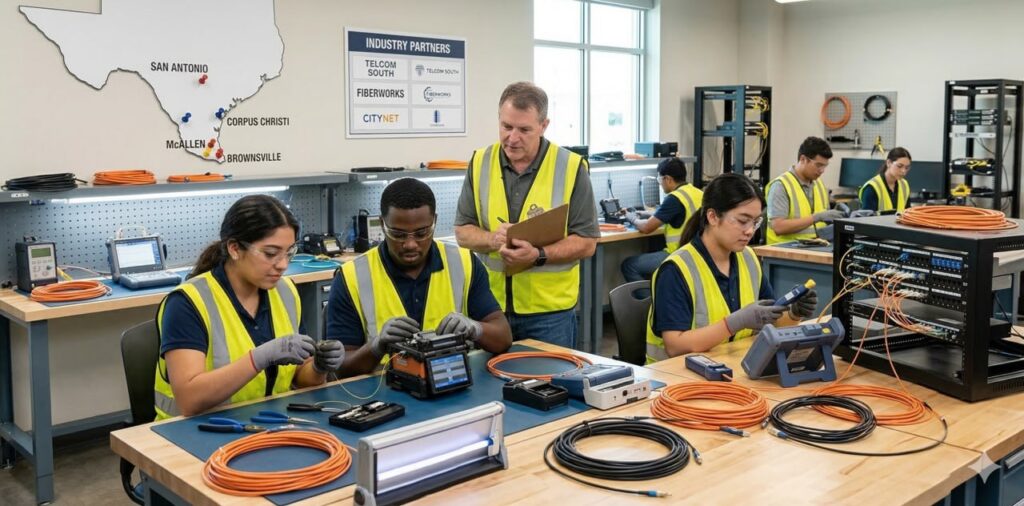
Laredo College’s mention of hands-on equipment and specialized faculty support is encouraging. Students in this pathway need repeated lab practice, not one-and-done demonstrations. Competence in fiber work comes from procedural repetition and performance under constraints: time pressure, diagnostic ambiguity, and quality thresholds.
The employer partnership element is equally important. Too many programs claim “industry alignment” without operationalizing it. True alignment requires regular feedback loops with hiring managers and field supervisors. That can include curriculum reviews each term, structured internship slots, mock interviews with employers, and shared scorecards tied to placement and retention.
For CTE administrators watching this launch, the key question is whether the program maintains a tight loop between training content and labor-market signal. If curriculum updates lag behind field practices, the credential loses practical power. If updates are frequent and employer-informed, the program becomes a reliable hiring channel.
Equity, access, and completion: the barriers that decide outcomes
The announcement also points to tuition support and reduced financial barriers. That is not just a nice-to-have detail. It can determine whether a workforce program reaches learners who are most likely to benefit.
In many communities, adults and recent graduates who could thrive in telecom roles are blocked by a short list of practical constraints: tuition cost, transportation, scheduling conflicts, childcare pressure, and uncertainty about wages after completion. Programs that confront these realities early tend to outperform those that focus only on curriculum design.
For this initiative to deliver on its promise of preparing roughly 150 learners, implementation details will matter:
- Scheduling flexibility. Evening and hybrid support can expand participation for working adults.
- Wraparound advising. Learners need help translating training milestones into job applications.
- Employer transparency. Clear wage ranges and role expectations improve persistence.
- Early intervention systems. Attendance and assessment checkpoints can prevent attrition.
A second equity question is who gets to transition from completion to high-quality employment. Programs sometimes report strong graduation numbers while placement quality is uneven across student groups. CTE leaders should monitor who is entering apprenticeships, who receives full-time offers, and who stays in role six to twelve months later.
If Laredo College pairs affordability supports with strong employer transitions, this can become a model for inclusive infrastructure careers. Broadband jobs can be a meaningful middle-skill pathway with wage growth potential, but only if entry and completion structures are intentionally designed.
What policymakers and CTE systems can learn from this approach
This launch sits at the intersection of three policy priorities: infrastructure readiness, workforce development, and regional competitiveness. That combination creates opportunities for replication, but replication should be disciplined.
For state and local leaders, the best lesson is not “start more programs.” The better lesson is “start targeted programs with measurable labor-market relevance.” A role-specific model with a trusted credential and employer pathway is easier to evaluate and improve than broad, generic training.
If other regions adapt this strategy, they should prioritize a few concrete design principles:
- Use demand data to define scope. Program size and curriculum should match real hiring patterns, not assumptions.
- Co-design with employers from day one. Avoid advisory boards that exist only on paper.
- Measure conversion, not just completion. Track placement speed, wage levels, and retention.
- Build stackability. Allow completers to progress into advanced telecom or network-specialist roles over time.
There is also a communications lesson for CTE systems. Stories like this help the public understand modern CTE as a serious talent strategy, not a fallback option. Fiber training connects to visible economic priorities: digital access, business continuity, school connectivity, telehealth, and smart infrastructure. That public relevance can strengthen support for sustained funding.
However, leaders should avoid overselling early outcomes. New pathways need one to two full cycles before claims about long-term effectiveness are credible. A transparent implementation dashboard can build trust while the program matures.
The good, the bad, what’s best?
There is a lot to like in this initiative, but long-term value depends on disciplined execution.
The good:
- The program addresses a clearly defined workforce need with direct occupational relevance.
- FOA credential alignment increases signal clarity for employers.
- Hands-on training design reflects what telecom jobs actually require.
- Tuition-support framing improves access for learners who might otherwise be excluded.
- Employer partnership emphasis creates a pathway to apprenticeships and job placement.
The bad (or risky):
- New programs can struggle with instructor pipeline quality and lab capacity.
- Placement outcomes may vary if employer demand softens or partner commitments weaken.
- Credential attainment alone does not guarantee durable employment without transition support.
- Rapid technology shifts can outdate curriculum if updates are not frequent.
- Program expansion pressure can reduce quality if scaling outruns infrastructure.
What’s best:
The strongest strategy is to treat this as a workforce system, not a single training product. That means committing to quarterly employer-informed curriculum tuning, publishing outcome metrics publicly, and resourcing student supports that improve completion-to-employment conversion. If those pieces stay intact, the model can deliver meaningful local impact and serve as a replicable framework for other broadband-growth regions.
✅ Expand targeted telecom CTE pathways, but govern for outcomes
Proceed with expansion, but tie growth to transparent placement and retention evidence.
Laredo College’s fiber initiative represents the kind of focused CTE design that policymakers and educators often ask for but do not always build: role-specific training, credential alignment, and explicit employer connection. It deserves support because it matches training supply to real labor demand and can open strong opportunities for learners in a critical infrastructure sector.
At the same time, success should be defined by outcomes beyond enrollment. The key performance question is not how many students enter the pathway; it is how many secure quality jobs, persist in them, and advance into higher-value technical roles. Institutions that track those indicators and adjust quickly will create durable workforce pipelines. Institutions that stop at program launch metrics will struggle to sustain impact.
If this program maintains quality while scaling responsibly, it can become a high-value CTE case study: a regional college helping solve a practical economic challenge through targeted, employer-informed technical education.