

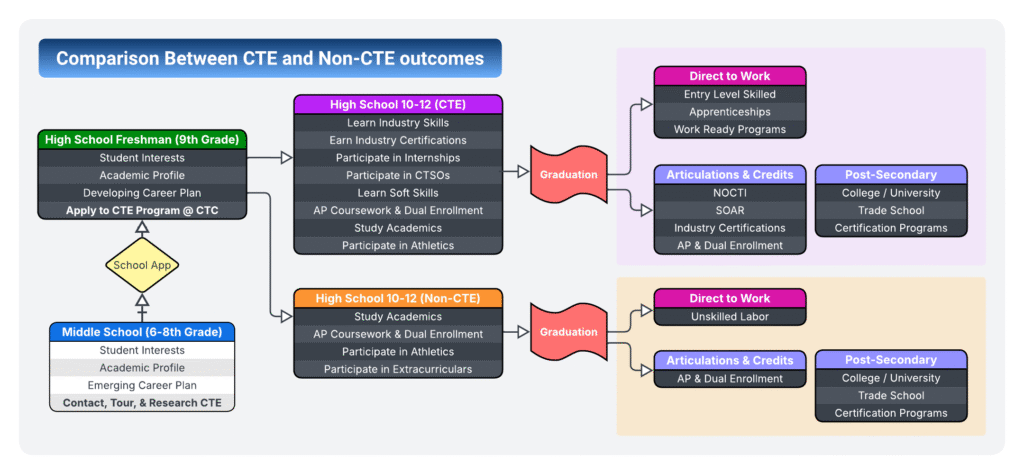
Choosing between a Career and Technical Education (CTE) pathway and a Traditional Academic pathway is about matching the learning environment to the student’s long-term goals. Neither is “better” in a vacuum, but one will likely be a much better “fit” for your child’s personality.
Here is a breakdown of the pros and cons to help you weigh the decision:
CTE / Technical Center Pathway
Focus: Specialized skill acquisition and immediate workforce readiness.
| Pros (The Benefits) | Cons (The Trade-offs) |
| Direct Earning Power: Students often graduate with industry certifications (AWS, ASE, CNA) that allow them to earn a living wage immediately, often $5,000–$7,000 more annually than peers without CTE training. | Early Specialization: If a student changes their mind about their career at age 17, they may feel “behind” in a different field, though the soft skills (work ethic, safety) are still transferable. |
| High Engagement: For students who struggle with “sitting still,” the hands-on nature of a shop or lab significantly reduces the risk of dropout and increases daily attendance. | Logistics & Social Gaps: Students often spend half the day away from their “home” high school, which can make it harder to participate in midday clubs or social events. |
| Debt-Free Foundations: Many programs offer Dual Enrollment, allowing students to earn college credits for free, potentially saving thousands on a future Associate or Bachelor’s degree. | Rigid Schedules: Because of the travel time between the high school and the CTC, students may have fewer slots for elective classes like Art, Music, or Foreign Languages. |
| Employer Networking: Through Co-Op programs, students work directly with local business owners, often securing a full-time job offer before they even walk across the graduation stage. | Upfront Costs: While tuition is free, some programs require parents to purchase specific gear (e.g., steel-toed boots, culinary kits, or professional shears). |
Traditional Academic Pathway
Focus: Broad-based knowledge and preparation for a four-year university.
| Pros (The Benefits) | Cons (The Trade-offs) |
| Maximum Flexibility: A broad curriculum allows students to explore multiple subjects (History, Psych, Physics) before committing to a major in college. | The “Skills Gap”: Many traditional graduates have high GPA scores but lack “marketable” skills, often leading to underemployment while they are in college or right after. |
| College Admissions Alignment: Standard high school tracks are perfectly synced with SAT/ACT prep and the “liberal arts” requirements most 4-year universities look for. | Higher Financial Risk: The “Bachelor’s or Bust” mentality can lead students into expensive 4-year degrees for careers they may not actually enjoy once they start working. |
| Social Continuity: Students remain in one building all day, making it easier to hold leadership roles in student government, sports, or local school activities. | Passive Learning: For kinesthetic learners, the lecture-heavy environment can lead to burnout or “checked-out” behavior by junior year. |
Student Outcomes: The Data Behind the Decision
Research from the American Institutes for Research (AIR), the National Center for Education Statistics (NCES), and state-level data indicates that CTE provides a significant “engagement boost.”
The Graduation Gap
CTE students consistently outperform the general student population in on-time graduation.
- The Statistic: In Pennsylvania, CTE concentrators (students who take at least two courses in a sequence) have a graduation rate of 94.7%, compared to approximately 87% for the general student population.
- Why it works: Students are 21% more likely to graduate when they see the direct relevance of their coursework to their future earning potential.
Immediate Workforce Integration
Unlike traditional pathways that often leave a gap between high school and career entry, CTE provides a “fast track.”
- The Statistic: Graduates with a technical or applied science associate degree (often started via CTE dual enrollment) can out-earn bachelor’s degree holders by $2,000 to $11,000 in their first few years of employment.
- The Benefit: Early entry into the workforce allows students to realization “cumulative lifetime earnings” advantages—they are earning while their peers are still incurring tuition debt.
College Persistence vs. Immediate Practicality
The path to a four-year degree looks different for CTE students.
- The Pattern: Traditional academic students show a higher rate of immediate four-year college persistence, largely because their curriculum is a “mirror” of university lectures.
- The Pivot: CTE students are more likely to pursue an Associate’s Degree first (14% vs 9% for traditional students). This “stackable” approach allows them to work in their field while finishing their degree, often with their employer paying the tuition.
Three Insights on CTE Success
- The “Wages & Benefits” Advantage Research shows that students who earn 3 or more CTE credits are not only more likely to be employed but are also significantly more likely to receive employer-sponsored health insurance and retirement benefits than their non-CTE peers.Example: A student in a Precision Machining program often enters a corporate apprenticeship that includes a 401(k) and full medical coverage by age 19—benefits many traditional college graduates don’t see until age 23 or 24.
- Reduction in “Underemployment” A major issue for 4-year college graduates is “underemployment”—working a job that doesn’t require their degree. CTE students face a much lower risk of this because they are trained for High Priority Occupations (HPOs) where a labor shortage already exists.
- Example: 7 out of 10 jobs in the next decade will not require a 4-year degree but will require specialized technical training. CTE students are positioned to fill these roles exactly.
- The “Nontraditional” Success Factor CTE has been shown to provide the greatest academic boost to students who traditionally struggle in a lecture-only environment, particularly male students and students with disabilities (SWD).
- The Data: For students with learning disabilities, CTE participation increases the likelihood of full-time employment by nearly 15 points, as the hands-on assessment allows them to demonstrate mastery through action rather than just written testing.
Decision Tip: If your child’s personality profile (from Step 2) came back as “Realistic” (the Doer) or “Investigative” (the Thinker), the CTE pathway is likely to be highly rewarding. If they came back as “Artistic” or “Social,” you should look specifically for CTE programs like Graphic Design or Healthcare to ensure the technical training matches their personality.


