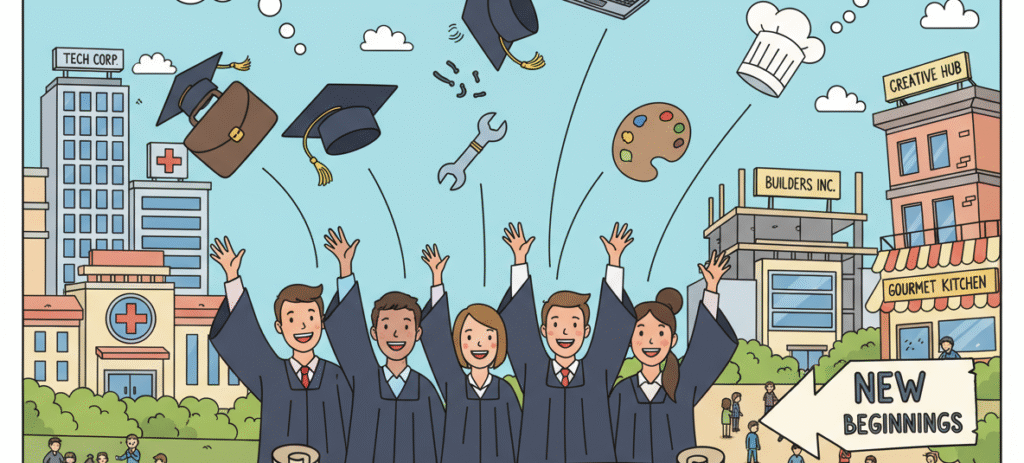

A High Priority Occupation (HPO) is a job identified by state and regional workforce systems as essential for economic growth, characterized by high employer demand, a requirement for higher skill levels, and the ability to provide family-sustaining wages Philly CTE HPO Guide, Philadelphia Works HPO List. These lists are a central component of Pennsylvania’s industry-driven approach to workforce development, ensuring that public and private investments in education are aligned with the actual needs of local businesses Philadelphia Works HPO List.
To be designated as an HPO, an occupation must typically meet three rigorous criteria: first, there must be a significant number of projected openings resulting from both industry growth and the need to replace retiring workers; second, the role must require specialized training, such as a postsecondary certificate or a college degree; and third, the pay must support a family’s financial stability Philly CTE HPO Guide, Advance Central PA Priority Occupations. Common examples of HPOs are found in sectors like Healthcare (e.g., Registered Nurses), Information Technology (e.g., Software Developers), and Skilled Trades (e.g., HVAC technicians or welders) Philly CTE HPO Guide.
Regional, State, and National HPO Resources
Identifying HPOs requires navigating multiple levels of government and institutional data:
• Regional: Local workforce development boards, such as Philadelphia Works, Inc. and Advance Central PA, manage lists specific to their geographic areas. For example, the Philadelphia County and Central PA lists for 2025-2026 are valid from August 1, 2025, through July 31, 2026 Philadelphia Works HPO List, Advance Central PA Priority Occupations.
• State: The Pennsylvania Department of Labor & Industry generates draft lists annually for every county. These lists are refined through a collaborative process where local boards and educational institutions can petition for the inclusion of specific occupations based on local sector partnerships or unmet talent needs Philadelphia Works HPO List.
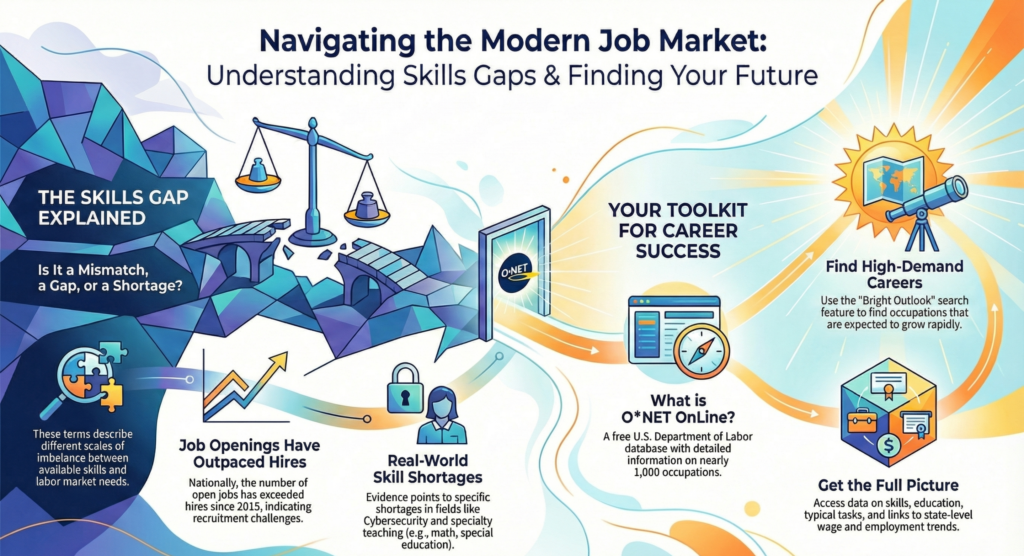
• National: The Bureau of Labor Statistics (BLS) provides the foundational data for HPOs through the Occupational Outlook Handbook and Employment Projections, which forecast demand for over 800 occupations a decade into the future BLS Information Guide, BLS 2024-2034 Projections. Additionally, the Occupational Information Network (O*NET) serves as a comprehensive database of job requirements and worker attributes O*NET Resource Center.
How to Read and Interpret HPO Resources
HPO resources provide deep data points that can be overwhelming without proper guidance. Here is what different stakeholders should prioritize:
• For Students: Focus on the SOC (Standard Occupational Classification) Title and the Annual Average Wages to see which careers offer the best return on their time Advance Central PA Priority Occupations.
• For Counselors and Teachers: Pay attention to the Educational Attainment abbreviations. Understanding the difference between PS (Postsecondary training), AD (Associate Degree), and BD (Bachelor’s Degree) allows for more precise academic track guidance Advance Central PA Priority Occupations. They should also look for “Bright Outlook” icons on O*NET, which indicate occupations expected to grow rapidly O*NET OnLine Features.
• For Parents: Review Entry Level vs. Experienced Wages. This shows not just what a child will make on day one, but the potential for significant earnings growth over time Advance Central PA Priority Occupations.
• For Researchers: Historically, analysts were warned against the “Vicious Quotient”—simply dividing total wages by total workers—which can be misleading. Modern HPO lists use more nuanced data to avoid these historical statistical mistakes BLS Centenary History.
Why HPOs and CTE Program Alignment are Essential
Aligning Career and Technical Education (CTE) programs with HPO lists is vital because it prevents “skill gaps,” where students graduate with certifications for jobs that are no longer in demand Philly CTE HPO Guide. Proper alignment ensures that:
1. Funding is optimized: Governments can direct training dollars toward programs that lead to immediate, high-paying employment Philly CTE HPO Guide.
2. Businesses thrive: Regional industries have a steady pipeline of workers trained in the exact competencies they need Philly CTE HPO Guide.
3. Students have security: Graduates move into roles with long-term stability rather than temporary or low-wage positions Philadelphia Works HPO List.
Fitting Student Interests with State and National HPOs
To find a match between personal passion and economic reality, the O*NET Interest Profiler is a powerful tool. It uses a 60-item self-assessment to generate scores based on the Holland Codes: Realistic, Investigative, Artistic, Social, Enterprising, and Conventional O*NET Interest Profiler Instructions, O*NET Resource Center.
Students should take their top interest areas and filter for HPOs within a specific Job Zone. For example, a student with a high “Social” score might explore HPOs in Healthcare Support, while an “Investigative” student might look at Data Science or Cybersecurity O*NET Interest Profiler Instructions. This approach connects personal aptitude with “Bright Outlook” jobs, ensuring the student is pursuing a viable career path O*NET OnLine Features.
Future-Proofing Education through CTE Schools
As we enter the Fourth Industrial Revolution, characterized by AI, robotics, and 3D printing, CTE programs must evolve to keep students competitive Harvard’s Future-Proof Skill Guide. Strategies to future-proof education include:
Emphasizing “Adjacent” Skill Sets: Teaching students how to pivot. For example, an administrative student can apply their organizational skills to a growth field like Digital Marketing Harvard’s Future-Proof Skill Guide.
Focusing on Green Jobs: As the economy shifts, demand for Solar Photovoltaic Installers and Wind Turbine Service Technicians is skyrocketing, making these roles high-priority and relatively recession-proof BLS 2024-2034 Projections, World Bank Green Jobs Paper.
Lifelong Learning: Instilling the habit of reskilling and upskilling, as at least 54% of all employees will require significant retraining to meet future technological demands Harvard’s Future-Proof Skill Guide.
Employment Trends: What Parents Need to Know
The U.S. economy is projected to add 5.2 million jobs between 2024 and 2034 BLS 2024-2034 Projections. Parents should note three critical trends:
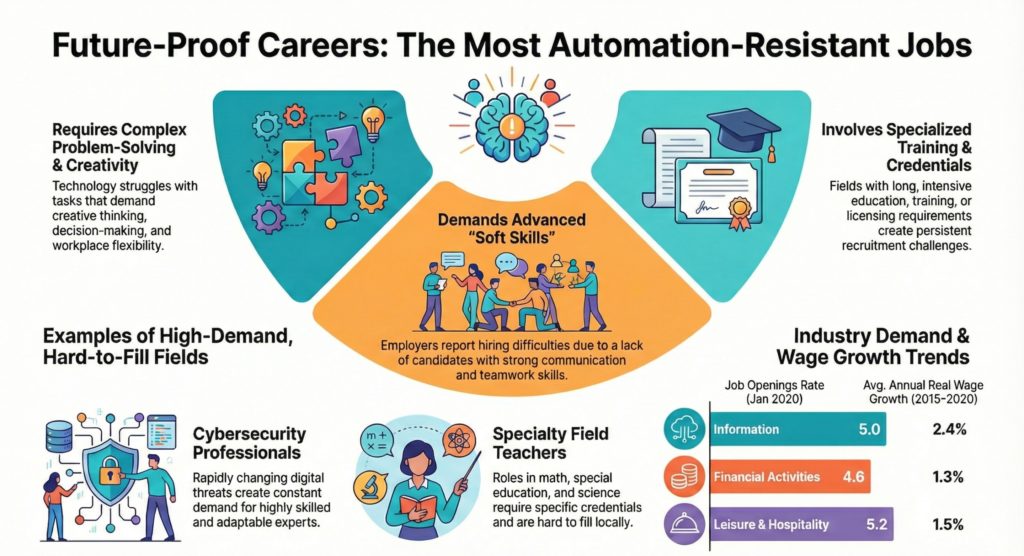
1. Healthcare Dominance: Driven by an aging population, this sector is the fastest-growing (+8.4%), with Nurse Practitioners and Physician Assistants leading the way BLS 2024-2034 Projections.
2. Tech and AI Integration: Demand for Data Scientists (+33.5%) and Information Security Analysts (+28.5%) will continue to surge as businesses integrate AI models BLS 2024-2034 Projections.
3. Automation Risk: Occupations in office support, retail sales, and basic production are expected to decline as machines take over routine tasks BLS 2024-2034 Projections.
The Role of Soft Skills Training
While technical skills get the job, soft skills keep it. Employers increasingly value uniquely human attributes that AI cannot yet replicate Harvard’s Future-Proof Skill Guide. Essential soft skills for students include:
• Critical Thinking and Problem Solving: These are ranked as the most important skills for high-level technical and managerial roles Harvard’s Future-Proof Skill Guide.
• Communication and Teamwork: Identified as the most in-demand competencies across almost all professional job postings Skills Gaps Review – Congress.gov.
• Emotional Intelligence: Vital for leadership and public-facing roles, helping workers navigate complex social dynamics that machines cannot understand Harvard’s Future-Proof Skill Guide.
Think of a regional economy as a professional theater production. The HPO list acts as the script, detailing exactly which roles are required for the show to be a hit—such as lead actors, set designers, and lighting technicians. CTE programs are the acting and technical schools preparing the cast. If the script calls for three expert lighting technicians (HPOs), but the schools only train lead singers, the production will fail because it cannot literally light the stage. Proper alignment ensures that when the curtain rises, every graduate has a specific, high-value role waiting for them on the stage.


Pingback: US Senate Hearing Explores New Paths to High-Paying Careers - Philly CTE
Pingback: Occupational Advisory Committees (OACs) - Life blood of a CTE program - Philly CTE