
A Defense Employer Steps Up as Sponsor, Not Just Advisor
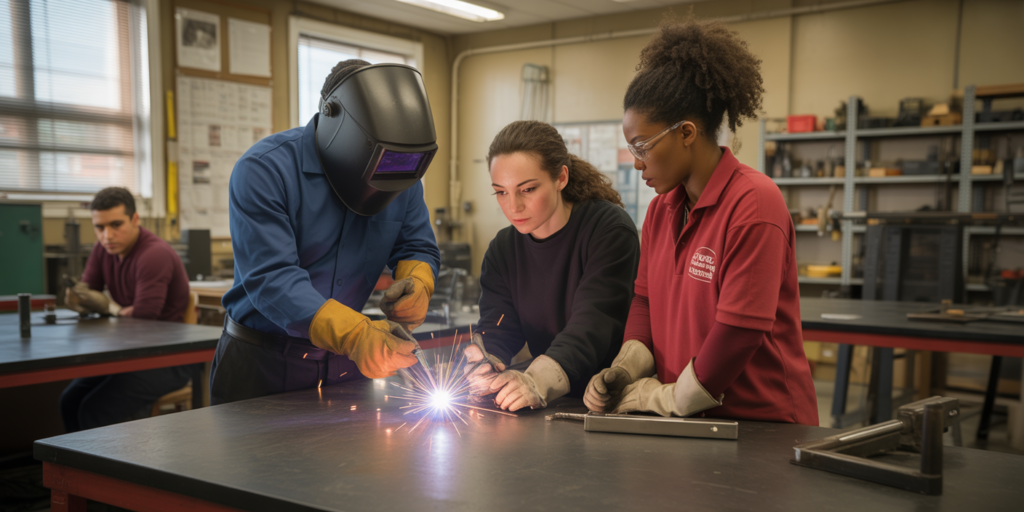
When DeVal Life Cycle Support agreed to sponsor WeldWorks Philly, the defense-industrial employer did something that most companies in the advanced manufacturing sector only talk about: it took ownership of a training pipeline. The $399,812 PAsmart Advanced Manufacturing grant, awarded to Philadelphia Works and announced February 27, 2026, funds a Registered Apprenticeship in welding that runs through June 2028. DeVal isn’t sitting on an advisory board offering input — it’s the program sponsor, which means it carries the operational and compliance responsibilities that come with a registered program under the Pennsylvania Department of Labor & Industry.
That distinction matters. In Philadelphia’s CTE ecosystem, employer engagement has historically been uneven. Companies attend career fairs, host occasional site visits, and offer guest speaker slots. Fewer take on the legal and administrative burden of sponsoring a Registered Apprenticeship. DeVal’s willingness to do so reflects both the severity of the welding talent gap in the region’s defense supply chain and a growing recognition that passive employer participation doesn’t build pipelines.
The individual-model apprenticeship structure is worth understanding. Unlike program-model registered apprenticeships — which are designed for cohorts across multiple employers — the individual model allows a single employer to register and run a program for its own workforce needs. This lowers the barrier to entry for mid-size employers that want structured training but can’t coordinate a multi-employer consortium. For DeVal, which specializes in life cycle support for defense systems, the welding competencies are specific enough that a tailored program makes more sense than a generic one.
The ApprenticeshipPHL Infrastructure Behind the Grant
Philadelphia Works isn’t new to this. The city’s workforce development board has been building its ApprenticeshipPHL platform for several years, positioning Philadelphia as a hub for registered apprenticeship expansion. The platform serves as a convener — connecting employers, training providers, and community organizations — and as a grant administrator that can package competitive applications for state and federal funding.
WeldWorks Philly is the latest product of that infrastructure. Philadelphia Works serves as project lead and fiscal agent, handling the grant administration while DeVal manages the on-the-ground apprenticeship delivery. The division of labor is clean: workforce board handles compliance and funding, employer handles training. It’s a model that other Pennsylvania cities have attempted with varying degrees of success, and Philadelphia’s version benefits from the density of advanced manufacturing employers in the region.
The grant includes supportive services funding — a critical but often overlooked component of apprenticeship programs. Transportation, childcare, tools, and testing fees can all become barriers to completion, particularly for apprentices from low-income backgrounds. Philadelphia Works has emphasized wraparound support in its recent PAsmart applications, and the inclusion of supportive services in WeldWorks Philly suggests that lesson has stuck.
What This Means for Philadelphia’s CTE Pipeline
For School District of Philadelphia CTE welding programs — housed in schools like Randolph Career Academy and Swenson Arts and Technology — WeldWorks Philly creates a tangible next step beyond the classroom. Students who complete a CTE welding program with industry-recognized credentials can potentially enter a Registered Apprenticeship that pays them while they earn additional certifications. That’s the promise of the CTE-to-career pipeline, and it’s one that Philadelphia has struggled to deliver at scale.
The enrollment target of five apprentices, however, is modest. Even accounting for the individual-model structure and the project’s startup phase, five apprentices over two years doesn’t move the needle on Philadelphia’s advanced manufacturing talent gap. The Bureau of Labor Statistics projects steady demand for welders in the Philadelphia metro area, and defense-sector employers like DeVal face competitive pressure from commercial manufacturing, construction, and energy employers all chasing the same skilled workers.
The real test is scalability. If WeldWorks Philly produces competent, credentialed welders who stay in the region’s advanced manufacturing sector, it becomes a proof-of-concept that other employers can replicate. Philadelphia Works has an incentive to make this work — every successful apprenticeship strengthens the city’s competitive position for future PAsmart rounds. But scaling requires more employer sponsors willing to take on the operational commitment, and it requires CTE programs that can reliably produce candidates with the foundational skills to enter a registered apprenticeship without extensive remediation.
Pennsylvania’s PAsmart Play
WeldWorks Philly is one data point in a much larger state strategy. Pennsylvania’s PAsmart initiative, administered by the Department of Labor & Industry, has been funding workforce development projects across multiple sectors since 2018. The Advanced Manufacturing track — which funded this grant — is one of several funding streams that target high-demand industries.
Philadelphia has historically underperformed on per-capita PAsmart awards compared to other regions of the state. Part of the explanation is structural: competitive grants favor applications with strong employer partnerships, and Philadelphia’s fragmented employer landscape can make it harder to assemble the kind of committed sponsor that rural and suburban regions with a single dominant manufacturer can offer. WeldWorks Philly suggests the city is getting better at this — Philadelphia Works and ApprenticeshipPHL are building the intermediary capacity that competitive grants reward.
The broader context is Pennsylvania’s projected shortage of skilled tradesworkers, estimated at 300,000 by 2030. No single grant closes that gap. But each successful program adds capacity, builds institutional knowledge, and creates a network effect that makes the next program easier to launch. WeldWorks Philly, if it works, becomes part of that cumulative infrastructure.
The good, the bad, what’s best?
The good: DeVal Life Cycle Support stepping up as a Registered Apprenticeship sponsor is exactly the kind of employer ownership that Philadelphia’s CTE ecosystem needs. The individual-model structure is accessible for mid-size employers, and the inclusion of supportive services addresses real completion barriers. Philadelphia Works’ ApprenticeshipPHL platform provides credible grant administration and convening capacity.
The bad: Five apprentices over two years is a proof-of-concept, not a pipeline. The enrollment target doesn’t match the scale of the region’s welding talent gap, and there’s no publicly articulated plan for scaling beyond DeVal. The defense-sector focus, while appropriate for DeVal’s business, limits the program’s relevance to the broader advanced manufacturing ecosystem. And the project period extending to mid-2028 means results will be slow to materialize.
What’s best: Philadelphia CTE leaders should treat WeldWorks Philly as a demonstration project and invest in the conditions for replication. That means strengthening the foundational welding skills coming out of CTE high school programs, building relationships with additional employer sponsors in adjacent manufacturing sectors, and tracking completion and placement outcomes rigorously enough to make the case for future, larger PAsmart investments. The model is sound. The scale needs to follow.
✅ Recommended: Monitor, Learn, and Prepare to Scale
WeldWorks Philly deserves attention from every CTE program director in Philadelphia who wants to see employer-sponsored apprenticeship work. The DeVal sponsorship model is replicable, the PAsmart funding mechanism is recurring, and Philadelphia Works has the infrastructure to administer more programs like this. Watch the outcomes, build the candidate pipeline from CTE welding programs, and be ready to partner when the next employer steps forward.
Source: https://drive.google.com/file/d/17ZEPKxbz6kbF05bwzPHyiZQSZ9ErZNBG/view?usp=drivesdk