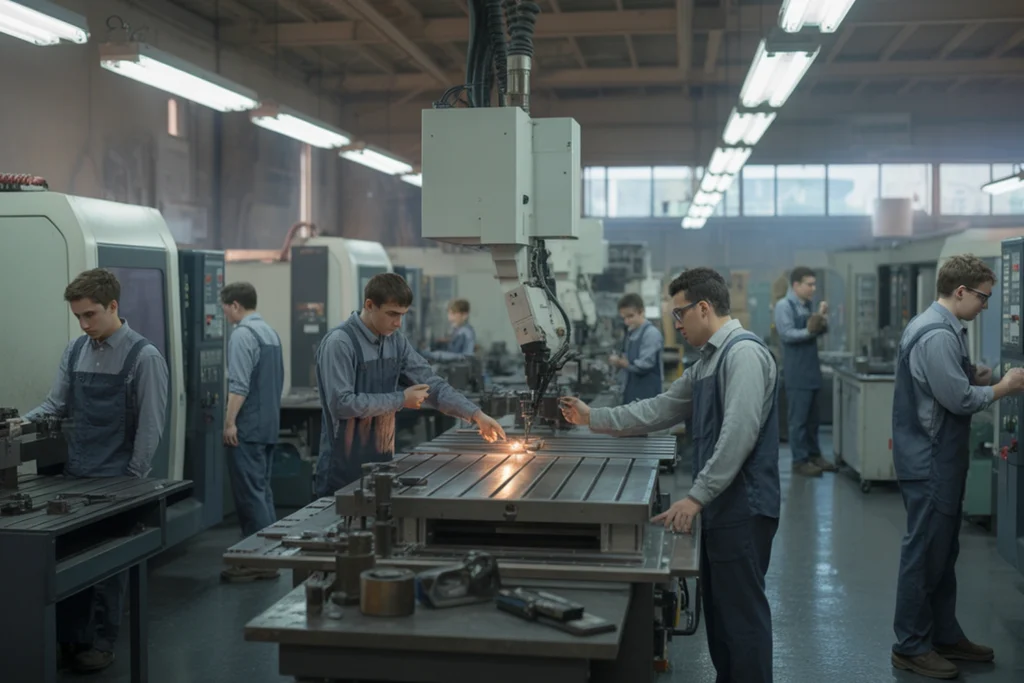

Manufacturing-focused career and technical education programs reported a 22 percent increase in enrollment nationwide during the 2025-2026 academic year, according to data compiled by the National Center for Education Statistics and the Association for Career and Technical Education. The surge follows three consecutive years of modest growth and arrives as domestic manufacturing construction spending reached $214 billion in 2025—a record driven by federal incentives and private capital committed to reshoring semiconductor, battery, and heavy equipment production.
The enrollment spike is not uniform across all CTE fields. Manufacturing, welding, precision machining, and industrial maintenance pathways saw the sharpest gains, while some healthcare and IT pathways saw enrollment plateau after pandemic-era surges. The shift signals a meaningful rebalancing of student interest toward production trades at a moment when the manufacturing sector is adding jobs faster than it can fill them.
What the Numbers Show
The NCES data, released in preliminary form in May 2026, tracks secondary CTE concentrator enrollment by career cluster. Manufacturing cluster programs grew from approximately 1.12 million concentrators in 2023-2024 to an estimated 1.37 million in 2025-2026—a 22.3 percent increase over two years. Welding and metal fabrication programs grew even faster, at 31 percent, while precision machining and CNC technology programs rose 28 percent.
The growth is concentrated in states with major manufacturing investments. Texas, Tennessee, Arizona, Ohio, and Michigan all reported manufacturing CTE enrollment gains above the national average. Texas added roughly 18,000 new manufacturing CTE concentrators, driven partly by Samsung’s $25 billion semiconductor fabrication complex in Taylor and the accompanying demand for skilled technicians. Tennessee saw a 34 percent jump in welding enrollment as the state’s automotive and battery manufacturing corridor expanded along Interstate 24.
Community colleges with strong CTE articulation agreements reported corresponding enrollment growth in their manufacturing and applied technology programs. Tennessee Colleges of Applied Technology saw a 19 percent increase in manufacturing program enrollment, while Maricopa County Community College District in Arizona reported a 24 percent increase in precision machining and automation technology enrollments.
Why Reshoring Is Driving the Surge
The enrollment growth is not occurring in a vacuum. A wave of domestic manufacturing construction—fueled by the CHIPS and Science Act, the Inflation Reduction Act’s clean energy manufacturing incentives, and private capital seeking supply chain resilience—has created visible demand for skilled production workers that students and parents can see in their communities.
The Semiconductor Industry Association estimates that the domestic semiconductor industry will need to fill roughly 115,000 new technician and operator roles by 2030 to staff fabs under construction or announced. Battery manufacturing, spurred by electric vehicle demand and the IRA’s manufacturing tax credits, is projected to need 140,000 additional production workers over the same period. Heavy equipment and aerospace manufacturing, supported by defense spending and infrastructure demand, are adding capacity in the Midwest and Southeast.
These are not abstract projections. They are visible construction sites, local news stories, and employer recruitment campaigns in communities where CTE programs operate. When a Samsung or TSMC breaks ground on a multi-billion-dollar facility thirty miles from a high school, the message to students about where the jobs are becomes concrete.
Employers are reinforcing that signal. Manufacturing employers have increased their direct engagement with CTE programs by roughly 40 percent since 2023, according to ACTE’s employer survey. The engagement takes the form of equipment donations, guest instruction, apprenticeship placements, and curriculum advisory input. Several major manufacturers—including Siemens, Boeing, and John Deere—have expanded their high school outreach programs and now explicitly recruit CTE concentrators for technician training pipelines.
How CTE Programs Are Responding
Programs that have grown enrollment successfully share several characteristics: strong employer partnerships, modern equipment, clear articulation to postsecondary credentials, and instructors with recent industry experience.
Equipment modernization has been a particular priority. Manufacturing CTE programs that have secured capital funding—through Perkins V, state CTE grants, or direct employer donations—have replaced aging manual lathes and mills with CNC machines, robotic welding cells, and programmable logic controller training stations. Students in these programs are training on equipment that matches what they will encounter in advanced manufacturing workplaces, not the machinery of thirty years ago.
The equipment investment matters because it affects both student interest and employer confidence. Students who visit a program and see modern CNC machines and robotic welding stations are more likely to enroll than those who see only manual equipment that does not match the industry’s current reality. Employers who see graduates trained on relevant equipment are more likely to hire directly from the program.
Instructor recruitment has been harder. Manufacturing CTE programs face the same teacher shortage that affects the broader education workforce, with an added challenge: instructors with deep industry experience can often earn significantly more returning to production or supervisory roles than they can in teaching. Programs that have solved this problem typically offer competitive salaries supported by state CTE teacher pay supplements, flexible scheduling that allows instructors to maintain industry connections, and grow-your-own pipelines that recruit experienced technicians into teaching through alternative certification routes.
Several states have created targeted solutions. Georgia’s CTE teacher apprenticeship program allows experienced manufacturing workers to teach while completing their educator preparation coursework, earning full salary from day one. Wisconsin’s Youth Apprenticeship program pairs high school students with manufacturing employers and counts the employer supervisor toward the school’s CTE instructor requirements under a cooperative education framework.
The Gender Gap Remains Stubborn
Despite the overall enrollment growth, manufacturing CTE programs remain overwhelmingly male. Women represented approximately 12 percent of manufacturing CTE concentrators in 2025-2026—up only slightly from 10 percent in 2020-2021. Welding and precision machining had the lowest female representation, at roughly 7 percent and 8 percent respectively.
Some programs have made deliberate efforts to address this. The Women in Manufacturing initiative, supported by the Manufacturing Institute, has partnered with thirty-seven high school CTE programs to provide mentorship, employer site visits, and scholarship support for female students in manufacturing pathways. Early results from partner programs show female enrollment rising to roughly 18 percent—still low, but a meaningful improvement.
Other programs have focused on outreach that challenges outdated perceptions of manufacturing work. Modern manufacturing involves robotics, automation, quality systems, and data analysis—not just manual labor—but public perception lags reality. Programs that invite prospective students and parents to see modern facilities report higher enrollment from students who had not previously considered manufacturing careers.
Challenges Ahead
The enrollment surge creates capacity pressure that many programs are struggling to meet. Welding programs in particular report waitlists and equipment shortages. A typical high school welding lab can train twenty to twenty-four students per year with four to six stations. Demand in some districts now exceeds forty students per year, and expanding lab capacity requires ventilation upgrades, electrical service, and square footage that many schools do not have available.
Funding is another constraint. Perkins V provides the baseline federal support for CTE programs, but the base grant has been flat in nominal dollars for years and has lost purchasing power to inflation. States with strong manufacturing sectors have generally supplemented Perkins with state CTE funding, but states with weaker fiscal positions have not kept pace. The result is a widening gap in manufacturing CTE capacity between well-funded and underfunded states.
Employer demand may also create a recruitment challenge for CTE programs themselves. As manufacturing employers compete aggressively for skilled workers, they are increasingly recruiting CTE instructors away from teaching. A welding instructor with AWS certification and ten years of industry experience is a valuable hire for both a school and a manufacturer. When the manufacturer offers 40 percent more compensation, the school often loses.
What This Means for CTE Directors
For programs with manufacturing pathways, the enrollment surge is an opportunity to expand capacity, deepen employer partnerships, and demonstrate value to district leadership. It is also a risk: rapid growth without adequate equipment, instructor quality, and employer coordination can produce graduates who do not meet industry standards, damaging the program’s reputation and employer relationships.
Programs that want to capture this moment should focus on three priorities.
First, secure capital funding for equipment modernization before enrollment growth outpaces capacity. Perkins V reserve funds, state CTE capital grants, and direct employer equipment donations are the most common sources. Document the enrollment demand and employer hiring commitments to strengthen grant applications.
Second, build instructor pipelines now, not when vacancies occur. Partner with local manufacturers on instructor sabbaticals, grow-your-own certification programs, or shared instructor models where an industry expert teaches part-time while maintaining their production role. Competitive compensation is essential; CTE teacher pay supplements or local funding solutions are often necessary to match market rates for skilled tradespeople.
Third, tighten employer partnerships beyond advisory boards. Employers who are desperate for workers will invest in programs that produce qualified candidates. Negotiate equipment donations, paid internships, apprenticeship pathways, and curriculum input in exchange for hiring commitments. The current labor market gives CTE programs leverage they have not had in decades.
—
Sources:
- NCES Preliminary CTE Concentrator Data 2025-2026 — National Center for Education Statistics
- ACTE Manufacturing Enrollment Trends Report — Association for Career and Technical Education
- Semiconductor Workforce Needs Assessment 2026 — Semiconductor Industry Association
- Manufacturing Construction Spending Reaches Record $214 Billion — U.S. Census Bureau
- Women in Manufacturing High School Initiative — The Manufacturing Institute