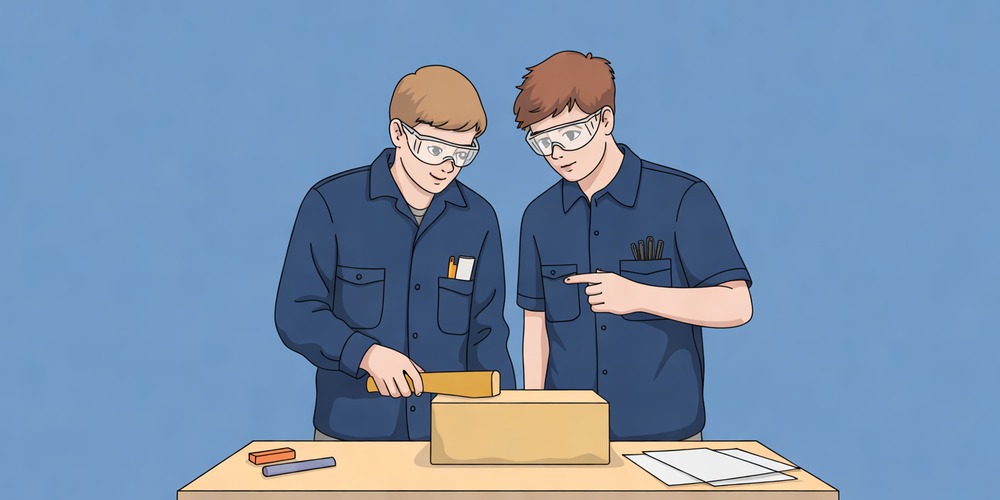

When one CTE instructor must watch 20 or 25 students, every minute of observation matters. A supervised reciprocal peer-teaching cycle gives each student a second job: perform the task, then watch a partner for one defined criterion. It can add useful explanation and observation without handing safety sign-off or final competence decisions to students.
The practical tension is control. Peer coaching can multiply the eyes in a welding booth, automotive bay, health-science lab, or information-technology workstation. It can also spread a wrong procedure, invite unsafe advice, or let a confident student hide a weak performance. The method works when the teacher narrows the task, teaches the observer role, and checks each student.
Build the routine around one observable criterion
Choose a task students already know or are preparing to perform. Use one line from an existing performance objective, task list, competency checklist, or National Occupational Competency Testing Institute (NOCTI) preparation activity. Do not introduce a new tool and a new peer-teaching method at the same time.
The criterion must be visible or checkable. Examples include maintaining a specified welding travel angle, following the posted diagnostic sequence, naming a circuit condition before testing, or completing patient identification and hand hygiene in the required order. Create a three-line observer card:
- I saw: the exact step or decision observed.
- The task says: the criterion, measurement, or sequence to follow.
- Try next: one safe adjustment for the next attempt.
The card focuses attention. The teacher remains responsible for safety, performance ratings, and final sign-off.
Run a 20- to 30-minute partner cycle
Use the same task card, personal protective equipment, tools, and station rules already required for the activity.
- Set the boundary, 3–5 minutes. State the task, the one criterion, the stop signal, and what students may not coach. Tell students that they may describe what they observe, but they may not approve a hazardous condition or direct a step outside the posted procedure.
- Model the observer role, 2–3 minutes. Demonstrate a short example with a volunteer or the task itself. Show one neutral observation and one next-step prompt. Do not model a dangerous error for entertainment or ask students to correct a live safety violation themselves.
- First attempt, 5–8 minutes. Student A operates or performs while Student B watches only the selected criterion and writes one line on the card. Circulate. If a safety risk appears, stop the task and use the program’s normal safety procedure.
- Swap roles, 5–8 minutes. Student B performs the same or a comparable task while Student A observes. Keep the criterion stable so students practice both the procedure and the language used to inspect it.
- Teacher check, 5–10 minutes. Ask each student to repeat the critical step or explain the adjustment. Complete the individual performance check yourself. Record whether the student met the criterion, needs another practice round, or needs prerequisite instruction.
With 25 students and limited equipment, pairs can share a station when the task permits it. The operator performs; the observer watches from the approved position. If the procedure requires one-person access, controlled energy, clinical privacy, or a specific instructor-to-student ratio, the program’s existing rule overrides the partner rotation.
Prevent misinformation and free-riding
The observer card limits advice, but it does not make every observation correct. Require students to point to the task card, posted standard, diagram, or measurement instead of presenting personal preference as the rule. Ask, “What did you see, and where is that criterion written?” That question makes the source of the correction visible.
Keep peer feedback descriptive rather than evaluative. “The sequence moved from inspection to recording without the required test” is more useful than “You did it wrong.”
If the observer cannot identify the criterion, pause and reteach before the next attempt.
Use role-swapping to reduce free-riding, but do not assume equal skill or equal confidence. Pairing can be changed by task, not by a permanent label of strong and weak. Students who need language support may use sentence stems. Follow each student’s approved IEP or 504 supports and program requirements. Confirm with the case manager when the approved competency target or method of performance differs.
The final individual check matters. A student who can repeat a partner’s words may still be unable to perform the procedure alone. The teacher should use the program’s normal rubric, safety checklist, or competency record, not the peer card, for the official judgment.
What the evidence supports, and what it does not
Chan and Leijten’s 2012 study, “Using Feedback Strategies to Improve Peer-Learning in Welding,” examined peer learning in a trade-training setting where students worked in individual welding booths. The intervention taught students feedback techniques rather than simply telling them to help one another. The accessible record reports gains in engagement, metacognition, and skill practice or learning after the intervention.
That study is a useful match for CTE because it addresses a hands-on trade setting and isolated workstations. It does not establish that every secondary CTE program will produce higher credential or NOCTI scores. The accessible record did not provide the full sample or effect-size detail needed for that claim.
A 2019 classroom action research study by Sandri Irmawan, “Application of Peer Tutoring Learning Methods in Vocational School Students,” involved 34 vocational high school students across two cycles. The abstract reports figures of 88.23% for knowledge and 91.17% for skills. It does not clearly identify them as scores, mastery rates, or percentage-point gains. Because it used a two-cycle classroom action research design without a comparison group, the results show what happened in that setting, not a controlled estimate of reciprocal teaching’s effect.
Gazula, McKenna, Cooper, and Paliadelis published a 2017 systematic review of reciprocal peer tutoring in tertiary health-profession education. The review included eight articles from searches covering January 2005 through February 2016. It found potential benefits for cooperative learning, communication, metacognition, teaching skills, and understanding, while calling for more research on learning outcomes. That is adjacent evidence, not direct proof for a high-school welding, automotive, construction, culinary, or health-science program.
The careful conclusion is modest: structured peer roles are a defensible way to add explanation and observation to procedural practice. The research does not justify unsupervised peer certification, peer safety approval, or a promise of better employment outcomes.
What this means for your program
Try one controlled cycle this month with normal resources:
- Select one existing performance objective. Choose a procedure that is safe to observe and has a visible criterion. Link it to the current task list or NOCTI preparation, but do not claim that the routine raises test scores.
- Prepare one observer card per pair. Use paper, a whiteboard template, or the program’s existing skills checklist. Materials should be the task card, PPE, current tools, and a pen or pencil.
- Reserve 20–30 minutes. Plan 3–5 minutes for boundaries, 2–3 minutes for modeling, 10–16 minutes for role-swapping, and 5–10 minutes for individual checks.
- Review the cards after class. Count which criterion caused confusion. Then decide whether the next lesson needs another practice round, a worked demonstration, or a smaller prerequisite task.
This routine is not a substitute for equipment, staffing, clinical supervision, or an industry partner’s performance standard. It is a way to make practice more observable when one instructor cannot stand at every station at once. For related implementation material, browse PhillyCTE’s CTE Resources and PA CTE Resources.
Sources
- Chan, S., and Leijten, F., “Using Feedback Strategies to Improve Peer-Learning in Welding,” International Journal of Training Research, 10(1), 2012, pp. 23–29. DOI: 10.5172/ijtr.2012.10.1.23. ERIC record accessed October 25, 2026. https://eric.ed.gov/?id=EJ971082
- Irmawan, S., “Application of Peer Tutoring Learning Methods in Vocational School Students,” Journal of Mechanical Engineering and Vocational Education, 2(1), 2019. DOI: 10.20961/jomeve.v2i1.28674. Accessed October 25, 2026. https://doi.org/10.20961/jomeve.v2i1.28674
- Gazula, S., McKenna, L., Cooper, S., and Paliadelis, P., “A Systematic Review of Reciprocal Peer Tutoring within Tertiary Health Profession Educational Programs,” Health Professions Education, 3(2), 2017. DOI: 10.1016/j.hpe.2016.12.001. Accessed October 25, 2026. https://doi.org/10.1016/j.hpe.2016.12.001
Last verified: October 25, 2026.