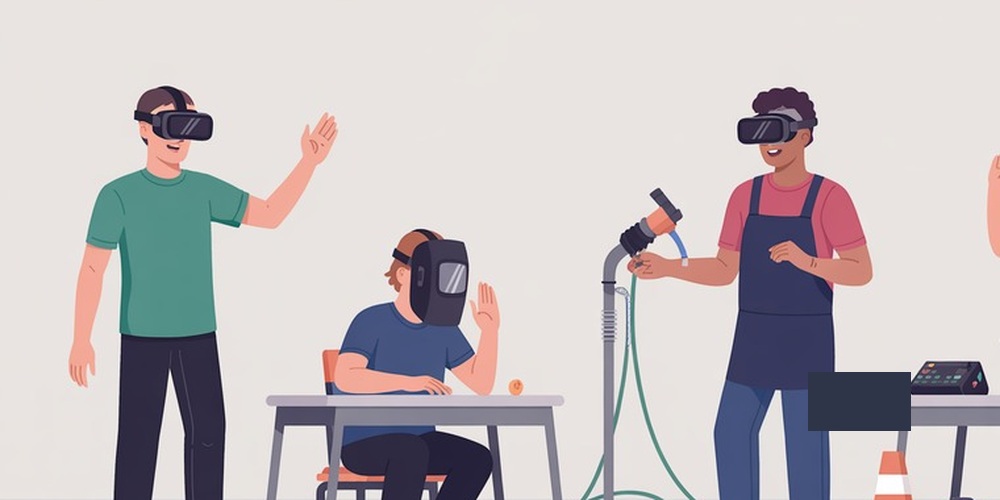

Headline: A rehearsal layer in simulation, designed around feedback and repetition, builds procedural skill and safety before students touch live equipment — without costing you more machines.
Every CTE instructor knows the bottleneck by feel. You have thirty students, four welders, two patient manikins, one CNC machine, and a clinical site that will only take students in pairs. The equipment is expensive, the procedures carry real risk, and the students who need the most reps get the fewest — because the thing they need to practice on is the thing you can least afford to let them touch unsupervised. The fix is not more machines. It is a rehearsal layer: let students work through the procedure in simulation, make their errors there, and build the muscle memory before they ever touch the live equipment.
The problem is reps, not motivation
The constraint in a CTE lab is access to scarce, hazardous, or costly equipment. A first-year welding student might get three supervised passes at the booth in a week. A pre-nursing student might practice a sterile dressing change once before the graded demonstration. That is not enough repetition to build procedural skill or safety habits — and the first live attempt is where costly mistakes happen, whether that means wasted stock, a blown panel, or an unsafe motion in a clinical setting.
The evidence says this is solvable. A systematic review of 78 studies by Radhakrishnan, Koumaditis, and Chinello (2021, Behaviour & Information Technology, DOI 10.1080/0144929X.2021.1954693) found immersive virtual reality to be a promising training method for industrial skills, with “high effectiveness scores” across the studies reviewed. That is the direct signal: simulation works for the technical, hands-on skills CTE teaches.
The method: a rehearsal layer, not a replacement
The key insight from the research is that simulation does not replace the lab — it precedes it. It is a low-risk, high-repetition rehearsal layer that lets students front-load their mistakes. A meta-analysis of 35 head-mounted-display trials (Wu, Yu, & Gu, 2020, British Journal of Educational Technology, DOI 10.1111/bjet.13023) found immersive VR improved learning performance over less immersive methods and traditional instruction. In welding specifically, a systematic review by Siang et al. (2022, Multimedia Tools and Applications, DOI 10.1007/s11042-022-12293-5) found VR and AR virtual welding systems can support psychomotor skill development before a student ever strikes a live arc.
But the most important finding is about design, not hardware. A landmark 289-study, 18,971-trainee review by Cook et al. (2012, Medical Teacher, DOI 10.3109/0142159X.2012.714886) isolated the specific features that drive simulation’s skill gains: feedback (effect size 0.44), repetitive practice (0.68), and range of difficulty (0.68), along with distributed practice and interactivity. In other words, dropping a VR headset into a lab does not help. Building deliberate practice — multiple attempts, error feedback, and varied scenarios — is what produces the gain.
The steps: add a rehearsal layer to one procedure this week
1. Pick the high-risk or bottleneck procedure. Identify the single procedure where errors are costly or equipment is scarce — a weld bead, a catheter insertion, a machine setup, a panel wiring, a dosage calculation. Start with one, not a program-wide overhaul.
2. Add a simulation pass before live equipment. Before students touch the real equipment, they complete a rehearsal run. If you have a VR or AR module, use it. If you do not, a desktop simulator, a guided video-walkthrough they narrate out loud, or a paper/tabletop run of the steps counts. The point is reps with feedback before risk — not expensive hardware.
3. Design for the features that actually work. Cook’s review names the active ingredients: feedback, repetitive practice, and range of difficulty. Build in multiple attempts, immediate error feedback, and varied scenarios — not a single one-shot demonstration. Let students fail in the sim and correct.
4. Gate live access on sim performance. Require a benchmark — an error-free or instructor-approved simulation run — before a student touches live equipment. This improves safety and makes your scarce equipment time more efficient, because the first live attempt is no longer the first attempt.
5. Cluster the applications by pathway. Welding: VR/AR weld trainer for bead and travel-speed reps before the booth. Healthcare: virtual patients or task trainers for vitals, injections, and sterile technique before clinicals. Construction and electrical: wiring and panel sims, and 3D safety walkthroughs, before live circuits. Manufacturing: CNC and machine-setup sims before cutting material. Automotive: diagnostic and torque-sequence sims before vehicles. Culinary: timed station and safety sims before service.
Classroom and lab implementation in Philadelphia
This translates directly into a Philadelphia CTE context. The health-professions evidence is the strongest for the clinical cluster: a systematic review by Kononowicz et al. (2019, JMIR, DOI 10.2196/14676) found virtual patients improved skills outcomes (standardized mean difference 0.90) compared with traditional education — the same mechanism a Health Sciences academy in the School District of Philadelphia can use to let pre-nursing students rehearse before a clinical rotation. For the trades, PDE-aligned welding and construction programs can use a VR weld trainer to front-load bead reps before students enter the booth, stretching limited equipment time across a larger cohort.
One caution belongs in every instructor’s planning: the direct randomized evidence on secondary CTE students is still thin. Most of the industrial-skill studies use adult workers or proof-of-concept designs, and the strongest design-feature evidence (Cook, Kononowicz) comes from health-professions populations — adjacent, not identical, to CTE. Treat the findings as strong directional support, not a guarantee, and watch for the real moderators the studies do not fully capture: hardware cost, access, and simulator sickness.
The good, the bad, what’s best?
The good: simulation lets you multiply safe reps on the exact procedures that currently get the fewest reps, and the evidence for skill gains — especially with feedback and repetition built in — is solid.
The bad: the hardware can be expensive and the transfer to live equipment is less consistently measured than in-simulation performance. Dropping in a headset without deliberate design buys you novelty, not skill.
What’s best: start with one procedure, use the cheapest simulation that gives feedback and repetition (even a narrated video walkthrough or tabletop run), and gate live access on a completed rehearsal. You do not need new hardware to begin.
✅ Recommendation: Add a simulation rehearsal layer to one high-risk or equipment-scarce procedure this week. Design it for feedback, repetition, and varied difficulty, and require a benchmark sim run before live equipment. Measure the result by counting error-free first attempts on the live equipment — not by hours in the simulator.
Sources:
- Radhakrishnan, Koumaditis & Chinello (2021), Behaviour & Information Technology — https://doi.org/10.1080/0144929X.2021.1954693
- Cook et al. (2012), Medical Teacher — https://doi.org/10.3109/0142159X.2012.714886
- Siang et al. (2022), Multimedia Tools and Applications — https://doi.org/10.1007/s11042-022-12293-5
- Wu, Yu & Gu (2020), British Journal of Educational Technology — https://doi.org/10.1111/bjet.13023
- Kononowicz et al. (2019), JMIR — https://doi.org/10.2196/14676