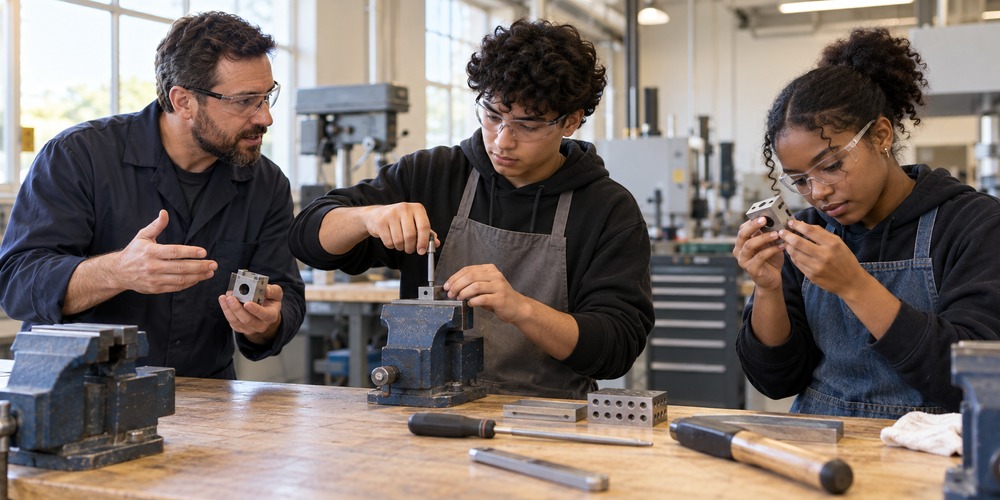

Week 3 of the CTE semester is the moment when instructors are moving students from orientation into the first real technical procedures — HVAC refrigerant handling, welding strikes, surgical prep, network cable termination, culinary station setup. The most common formative approach is exactly what most instructors were trained to do: watch a student perform a task, catch the error, correct it.
That approach is not wrong. But it is reactive by design. Errors get caught after they happen. By the time the instructor identifies a procedural mistake, the student has practiced the mistake — reinforced it — and may have to unlearn it before relearning the correct procedure.
There is a more powerful and immediately implementable alternative: build think-aloud protocols and student self-monitoring checklists into lab procedures, so students catch their own errors before the instructor does.
The Core Problem: Reactive Correction vs. Proactive Self-Monitoring
The formative assessment cycle in most CTE labs works like this: student performs → instructor observes → instructor corrects. The instructor is the quality control gate. The student’s role is to receive correction.
The alternative — self-monitoring — puts the quality control function inside the student’s cognitive process. Instead of waiting for external correction, the student evaluates their own performance against a known standard, in real time, at designated pause points in the procedure.
This matters for two distinct reasons. The first is practical: students who can catch their own errors before the instructor does complete procedures faster, with fewer re-dos, and with better retention of the correct technique. The second is workforce-relevant: self-monitoring is a core employability skill in every technical trade. Journeymen in HVAC, welding, electrical work, and healthcare are expected to evaluate their own work against codes and standards — not wait to be told they made a mistake. If CTE programs graduate students who still need an instructor standing over them to catch errors, those graduates are not fully prepared for the expectation of self-supervision on the job.
The Evidence: What Learning Science Says About Self-Monitoring and Think-Aloud
The combination of think-aloud protocols and self-monitoring checklists is not an instructional trend — it has a substantive evidence base in the learning sciences, with direct applicability to vocational and technical education contexts.
On self-monitoring checklists: A 2011 study in Learning and Instruction (cited 271 times) found that explicitly training secondary and postsecondary students in self-assessment and appropriate task selection produced significant improvements in self-regulated learning and performance in both academic and vocational contexts. The key finding: self-assessment accuracy is learnable, not innate. Students who received explicit training in using criteria to evaluate their own work improved more than students who received the same instruction without the self-assessment component. This maps directly to what a CTE lab checklist can do — if the checklist is taught as an evaluative skill, not just a paperwork exercise.
A 2019 critical review in Frontiers in Education examined 76 empirical studies on student self-assessment and found consistent results: self-assessment accuracy improves with explicit criteria, training, and domain-specific rubrics. Accuracy is higher in domains with clear, observable performance standards — which describes most CTE lab procedures precisely. The review’s limitation is important for CTE implementation: the effect was strongest for students who already had some domain expertise, and weaker for true novices. This is not a reason to skip self-monitoring checklists. It is a reason to introduce them at the right point in the skill progression.
On think-aloud protocols: A 2023 article in Medical Teacher synthesizing evidence on think-aloud methodology found that verbalizing reasoning during procedural task performance reveals decision points and judgment calls that are invisible during silent performance. In medical education — a procedural training context that has strong parallels to CTE lab instruction — think-aloud is an established technique for capturing the cognitive processes underlying technical skill. The 2010 Learning and Instruction study on metacognitive-strategies-based instruction found that vocational college students exposed to explicit metacognitive training (including monitoring and self-evaluation) showed significantly improved learning outcomes compared to control groups.
Important implementation caveat from the evidence: Several sources note that self-assessment accuracy depends on having sufficient domain knowledge to make valid judgments. A student who is encountering a procedure for the first time may lack the schema to recognize whether their performance is correct. This does not mean the checklist fails — it means the checklist should be introduced after students have enough procedural knowledge to use it meaningfully. Handing a 5-item rubric to a student who cannot yet perform the procedure’s basic sequence will produce compliance behavior without the metacognitive benefit. The sequence is: teach the procedure, then teach the checklist as an evaluation tool.
Three Techniques for Immediate Classroom Use
Think-aloud protocol. At the start of a new procedure, the instructor demonstrates while narrating every decision — not just the physical steps, but the reasoning behind them. (“I’m checking the MSDS first because I need to confirm the flash point before I open this container.”) The narration makes the invisible cognitive work visible. Then students perform the same procedure narrating their own decisions aloud, even if only to themselves. For a welding student setting up a shielded metal arc welding station: “I’m selecting 7018 rod because the joint configuration calls for a medium-penetration electrode; I’m setting the machine to 110 amps because that’s the range for a 3/16-inch rod on a V-groove joint.” The verbalization forces the student to process the reasoning, not just execute the physical motion.
After students have attempted the think-aloud once, the instructor can review a transcript of student narrations — even recorded casually — to identify systematic reasoning gaps. This is a powerful diagnostic: a student who narrates “I’m striking an arc” without specifying angle, amperage, or travel speed has a mental model gap that simply watching correct performance would not reveal.
Self-monitoring checklist. Create a 5- to 7-item rubric checklist for each procedure being taught. Items should be observable and binary: PPE worn correctly (yes/no), pressure reading within acceptable range (yes/no), connection verified before energizing (yes/no). Introduce the checklist after students have learned enough of the procedure to recognize correct vs. incorrect performance. At designated pause points — after equipment setup, before operation, after cleanup — students check themselves against the list before proceeding.
The checklist should not be used as a grading instrument. Its function is formative: students use it to catch their own errors before the instructor evaluates them. A student who finds and corrects their own mistake during a pause point has learned more than a student who is told by the instructor that they made the same error.
Pair with retrieval practice. The self-monitoring checklist pairs naturally with the retrieval practice techniques many CTE instructors already use in modified bell-ringer formats. At a pause point, before students check the list, ask them to name the next three steps from memory. This forces recall rather than recognition. Then students check the list — which creates a cognitive comparison between what they retrieved and what the standard requires. Research on the testing effect consistently shows that this retrieval-to-comparison cycle produces stronger retention than re-reading or passive review.
CTE Cluster Applications
The think-aloud and checklist framework adapts across career clusters:
- Welding: Narrate amperage and polarity selections before striking; use a pre-flow checklist (PPE, ground clamp placement, electrode selection, work angle) at each setup.
- HVAC-R: Verbalize the refrigerant handling sequence (isolating valve, gauge connection, recovery, leak check) before each procedure; checklist for EPA 608 compliance checkpoints.
- Healthcare/Allied Health: Narrate patient identification and vitals assessment sequence; checklist for infection control compliance at chairside and bedside positions.
- IT/Networking: Verbalize the cable termination sequence and port assignment logic before terminating; checklist for continuity test, label verification, and documentation.
- Automotive: Narrate the diagnostic protocol sequence before connecting scan tools; checklist for fluid levels, tire torque, and safety restraint check.
- Culinary: Verbalize the food safety checklist sequence at station setup; checklist for temperature monitoring log, timestamp, and allergen separation.
The same structure applies across all of them: observable standard, binary check, pause point before proceeding.
What This Approach Builds That Observation Alone Cannot
The self-monitoring checklist is not primarily a classroom management tool. It is a mechanism for building the metacognitive skill that technical careers require. In the trades and technical professions, self-supervision is the norm. A journeyman HVAC technician on a service call is expected to evaluate their own work against EPA regulations and manufacturer specifications, identify errors before they leave the job site, and document their own quality control. A graduate who arrives on a work site still waiting for someone to catch their mistakes is not job-ready, regardless of their technical knowledge.
Teaching self-monitoring in the CTE lab — explicitly, with a structured checklist, at real pause points — is how programs build that skill systematically. The evidence base is clear: self-assessment is learnable, it improves with explicit criteria and training, and it transfers to real-world task performance. The implementation requirement is modest: a revised procedure sheet, a short instructor demonstration of the think-aloud method, and a clear expectation that students use the checklist as their own quality control tool, not as a way to demonstrate compliance for the instructor.
Pick one procedure. Build a 5-item checklist. Introduce it this week.
Sources:
- Training self-assessment and task-selection skills — Learning and Instruction (2011)
- Twelve tips for applying the think-aloud method — Medical Teacher (2023)
- A Critical Review of Research on Student Self-Assessment — Frontiers in Education (2019)
- The Future of Student Self-Assessment — Educational Psychology Review (2015)
- Metacognitive-Strategies-Based Instruction for Vocational College Students — English Language Teaching (2010)