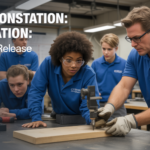

Governor Josh Shapiro wants Pennsylvania to graduate students who can do something specific. On April 10, the Shapiro administration announced $10.35 million in PAsmart Advancing Grants for Career and Technical Education — money aimed directly at expanding computer science and STEM-focused CTE programming at career and technical centers and school districts across the Commonwealth. The grants are the latest move in a deliberate, multi-year push to treat CTE as a core workforce development instrument, not a secondary alternative to a four-year degree.
Acting Secretary of Education Dr. Carrie Rowe framed the investment as part of a broader Shapiro strategy: increase support for all postsecondary pathways, not just traditional four-year college. Since taking office, the Shapiro administration has directed nearly $65 million in new vo-tech, CTE, and apprenticeship funding — roughly 50% above prior baseline levels. The PAsmart grants build on that base by targeting schools and CTCs that can demonstrate employer alignment and expand enrollment capacity in high-growth technical fields.
What the Grants Are Designed to Do
The PAsmart Advancing Grants are not general-purpose CTE funding. They are specifically scoped to computer science and STEM CTE — fields the state identifies as having acute employer demand and limited current supply. This is an intentional concentration, not a scatter-shot expansion. The Shapiro administration is betting that directing grant dollars toward specific, demand-aligned fields will produce graduates who can move directly into recognized apprenticeships or postsecondary credential pathways in those fields.
That is a defensible theory of change. National labor market data consistently shows STEM and computer science occupations commanding wage premiums and demonstrating strong job growth projections. Aligning CTE expansion with those fields gives the state’s investment a clearer outcome target than funding would if spread across all CTE program areas equally. It also creates a natural reporting framework: if the grants are working, enrollment in STEM CTE programs should increase, credential attainment in target fields should rise, and — in an ideal measurement environment — program graduates should enter related employment at measurable rates.
Pennsylvania is not yet operating in that ideal measurement environment. The credential quality questions raised in Philadelphia’s experience (covered in the April 11 local story) suggest that even STEM-aligned credential expansions can fold into a pathway with limited outcome accountability unless the state builds in verification infrastructure. The PAsmart grants are targeted at the right fields. Whether they produce the right credentials in the right concentrations is a question the state is not currently equipped to answer definitively.
The CTE Access Equation
Pennsylvania’s CTE landscape has historically been uneven. Career and technical centers across the state serve different student populations, offer varying program quality, and maintain different levels of employer engagement. Rural CTCs face different constraints than urban ones. Some programs have deep apprenticeship articulation agreements with employers; others operate with minimal employer input and rely on credentials of unverified value.
The Shapiro administration’s PAsmart grants are explicitly targeted at schools and CTCs that can show employer alignment — meaning grant applications are scored in part on the strength of documented employer partnerships and the demonstrated capacity to expand enrollment in demand fields. That is a meaningful conditionality. It pushes programs to bring employers into curriculum design, assessment, and credential endorsement — the factors that make a credential actually recognized in the labor market.
But conditionality in the grant application is different from conditionality in outcomes reporting. The PAsmart program should require programs to report not just enrollment numbers and credential attainment rates, but post-program employment and wage data — ideally at the individual credential level. Without that feedback loop, the state can claim the investment expanded access to STEM CTE. It cannot claim it produced durable labor market outcomes.
CTE directors and school administrators receiving PAsmart funding should be thinking about this now, not after the grant cycle closes. Articulation agreements between secondary CTE programs and registered apprenticeship systems or postsecondary credential pathways are the mechanism that turns a grant-funded program into a durable pipeline. Students who earn credentials through PAsmart-funded programs should be able to carry those credentials into registered apprenticeship or into college credit-bearing sequences at partner institutions. Building those agreements takes time and institutional relationships — time that should begin the day a grant is awarded, not at the end of a reporting period.
The $65 Million Context
Nearly $65 million in new CTE, vo-tech, and apprenticeship funding over two budget cycles is a meaningful number in a state that has historically treated CTE as a secondary budget priority. The Shapiro administration is making a coherent political argument: Pennsylvania needs a workforce pipeline that runs through technical fields, and the state has an obligation to invest in the infrastructure that produces it.
That argument is more persuasive when the investments produce measurable outcomes. Enrollment growth in STEM CTE programs, credential-to-employment data, and employer satisfaction metrics are the evidence base that justifies continued funding in future budget cycles. The PAsmart grants are a down payment. The follow-through on outcomes reporting — by CTE programs, by the state, and by the Shapiro administration — will determine whether this investment cycle becomes a model other states replicate or a line item that doesn’t survive the next budget negotiation.
The good, the bad, what’s best?
The good: The Shapiro administration is directing CTE expansion toward fields with documented employer demand, not spreading resources across all programs equally. The $10.35 million in PAsmart grants targets computer science and STEM — fields with measurable wage premiums and job growth. The explicit employer-alignment condition in grant applications pushes programs toward the kind of employer engagement that makes credentials actually recognizable in the labor market. Nearly $65 million in new CTE funding over two budgets is a serious commitment.
The bad: Expanded access to STEM credentials is not the same as credential quality assurance. Pennsylvania’s graduation pathway system, as documented in Philadelphia, lacks a mechanism to distinguish high-value from low-value credentials. PAsmart grants may increase the supply of STEM credentials without resolving the quality question — particularly if programs face pressure to get students credentialed without equivalent pressure to demonstrate those credentials lead to related employment. Outcomes reporting requirements for the grants will determine whether the investment produces durable results or one-time enrollment bumps.
What’s best? CTE leaders at the local level should use PAsmart grants to build infrastructure, not just enrollment. Articulation agreements with registered apprenticeship programs and postsecondary institutions are the mechanism that makes a credential portable and durable. Programs receiving PAsmart funding should track credential-to-employment outcomes from day one and publish that data as part of the program’s public accountability record. The Shapiro administration has made a strong down payment. The follow-through — on outcomes reporting, on credential quality, and on program-to-employment linkage — will determine whether Pennsylvania’s CTE investment model becomes one the nation watches or one that fades into the budget fine print.
✅ PAsmart grants are a strong CTE investment — but only if Pennsylvania builds the outcome-tracking infrastructure to prove they work.
Source: https://drive.google.com/file/d/1MZOdQFCB7mDUYcAF5tNppnM1uwED7bIC/view