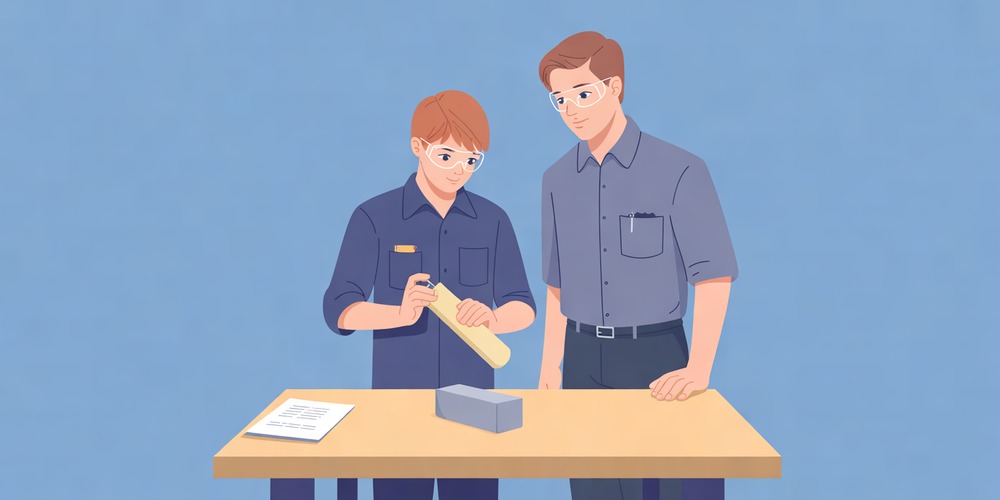

A safety test can show whether students remember rules. A five-minute, teacher-reviewed scan asks them to apply those rules before a task begins. Students name the hazard, exposure, control, verification step, and stop condition.
That distinction matters in a welding booth, automotive bay, construction shop, health-science lab, culinary station, or technology workspace. The scan is not a replacement for personal protective equipment (PPE), guards, supervision, or posted procedures. It makes safety reasoning visible before tools are energized, materials are handled, or a clinical procedure starts.
Why a safety lecture is not enough for hands-on work
Pennsylvania already places safety practice inside vocational education. Section 339.23 of Title 22 of the Pennsylvania Code says safety instruction must be practiced in the laboratory and classroom. It also requires equipment guards and personal safety devices to be in place and used, and it ties safe enrollment to room size and the number of workstations.
The Pennsylvania Department of Education’s Promoting a Safe School Environment: A Handbook for Pennsylvania Career and Technical Educators makes a related point. Its March 2021 guidance describes hazard identification and prevention as part of an ongoing safety program, not a one-time orientation. The handbook also frames accident prevention around engineering, education, and enforcement: set up the task safely, teach the safe method, and confirm that students follow it.
PhillyCTE’s read: A rules quiz checks recall, while a short scan checks how students apply the program’s procedures to the next task. The scan gives the instructor a chance to correct an unsafe assumption before work begins.
Use four prompts and one stop condition
Give each student a half-sheet or add five lines to an existing task card. Before the task begins, students answer:
- Hazard: What could cause harm in this task?
- Exposure: Who or what could be affected, and how?
- Control: What will prevent or reduce the risk?
- Verification: What will you check before starting?
- Stop condition: What would make you pause and call the instructor?
The stop condition is the safeguard. Students identify when work cannot continue without teacher review; they do not approve hazardous work.
Keep answers tied to the actual task. In an automotive activity, a student might identify an unexpected vehicle movement risk and who could be in its path. The student then names the required control and the condition that requires an instructor to stop the setup. In health science, the scan might focus on patient identification, exposure control, privacy, and the step requiring a teacher check. The teacher supplies the procedure; the student practices applying it.
Run the scan in one lab period
Plan about 5 minutes once students know the prompts. Start with one recurring task rather than adding it to every activity at once.
1. Name the task and boundary. State the procedure, the approved equipment or materials, the PPE, and the stop signal. Tell students that the scan supports the program’s safety rules; it does not replace them.
2. Give silent think time. Students complete the five prompts individually. This prevents the most experienced or confident student from supplying every answer. It also gives the teacher a quick view of what students notice without prompting.
3. Scan for the highest-risk misunderstanding. Read responses while students prepare. Look for missing controls, unsafe assumptions, or a stop condition that is too vague to use. Do not treat the sheet as a paperwork exercise. If a response reveals a hazard, correct it before the task begins.
4. Clarify one point for the whole group. Choose the most common error and address it in a short mini-lesson. Point to the task card, equipment label, safety data sheet, posted procedure, or measurement that supports the correction.
5. Release work only after the normal teacher check. The scan does not authorize a student to operate equipment. The instructor still confirms the setup, PPE, guards, workstation access, and any pathway-specific requirements.
For a large class, collect responses by station or use a visible board with no student names. With 25 students and one set of equipment, every student can write before rotation. The routine needs no paid platform, but the teacher must protect the few minutes needed to catch a wrong assumption.
What the evidence supports, and what it does not
The research supports treating safety instruction, training, supervision, and class conditions as serious parts of hands-on program design. It does not provide a controlled test of this exact five-minute routine.
Love, Roy, and Sirinides’ 2023 Safety Science study examined 718 STEM and CTE teachers in 42 states. Their exploratory correlations and logistic regression estimates used self-reported accidents over five years. The study identified eight factors associated with more accidents and 17 associated with fewer. Its model estimated 48% higher accident odds for classes over 24 students, but that estimate had a p-value of .08 and did not meet the conventional .05 threshold. The observational design does not prove that class size or one practice caused an accident.
Love, Threeton, and Roy’s 2024 Journal of Technology Education study analyzed 191 northeastern K–12 technology-and-engineering educators, including 67 from Pennsylvania. It identified 10 risk factors and two protective factors. After accounting for the measured risk and protective factors, the paper reported 83% lower estimated accident odds among teachers who had undergraduate safety training. That regional, non-experimental result does not prove that the training caused the difference or that a hazard scan prevents injury.
A 2021 focus-group study by Threeton and colleagues examined safety teaching and hearing protection among automotive and diesel instructors in one eastern state. It did not estimate this routine’s effect.
PhillyCTE’s read: A five-minute scan is a practical way to rehearse task-level safety reasoning within Pennsylvania’s existing safety expectations. The cited studies do not test this routine. Do not present it as an injury-reduction program, a compliance shortcut, or a proven path to higher scores from NOCTI, a technical-skills assessment provider.
What this means for your program
Try the routine before one recurring task this month. Use the materials already in your lab: the current task card or performance objective, a half-sheet, writing tools, posted PPE and equipment rules, and the teacher’s normal safety checklist. Plan 5 minutes for the scan, then use the first class’s responses to shape the next safety explanation.
Use these two actions:
- Make the scan part of an existing competency. Add the five prompts to a task students already perform or to a relevant NOCTI preparation activity. Score it as a safety sign-off or instructional check only if that matches your program’s approved assessment process. Do not create a new credential claim from it.
- Track the missed control, not just completion. After class, group responses by the hazard or control students missed. Start the next period with a two-minute correction, a labeled demonstration, or a prerequisite task. Keep the scan focused on the next decision students must make.
After two or three uses, ask whether the routine fits the pathway. A construction shop may need a setup check; health science may need privacy and infection-control prompts. Automotive or manufacturing may need a clear energy-control boundary. The format can change, but the teacher’s responsibility does not.
A hazard scan is useful because it turns a broad rule into a visible decision before work starts. Keep it short, keep it tied to the task, and keep the final safety judgment with the qualified instructor.
Last verified: November 1, 2026.
Sources
- Pennsylvania Department of Education, Bureau of Career and Technical Education, Promoting a Safe School Environment: A Handbook for Pennsylvania Career and Technical Educators, March 2021. https://www.pa.gov/content/dam/copapwp-pagov/en/education/documents/instruction/career-and-technical-education/teacher-resources/promoting%20a%20safe%20school%20environment.pdf
- Commonwealth of Pennsylvania, 22 Pa. Code Chapter 339, § 339.23: Vocational education safety, accessed November 1, 2026. https://www.pacodeandbulletin.gov/secure/pacode/data/022/chapter339/022_0339.pdf
- “A National Study Examining Safety Factors and Training Associated with STEM Education and CTE Laboratory Accidents in the United States,” Safety Science, 2023. https://doi.org/10.1016/j.ssci.2022.106058
- “A Safety Study on Educators of Technological and Engineering Design-Based Instruction in K-12 STEM Related Courses,” Journal of Technology Education, 2024. https://doi.org/10.21061/jte.632
- “An Investigation of Instructional Practices Which Promote Occupational Safety and Health,” International Journal of Occupational Safety and Ergonomics, 2021. https://doi.org/10.1080/10803548.2019.1659000